


What is a chiller?

The most important refrigeration cycles
Various cycles are used to create cold, the most important of which are the compression refrigeration cycle, the absorption refrigeration cycle, and the thermoelectric refrigeration cycle.
A history of chillers
The word chiller comes from the Latin Word Chill, meaning to cool. In 1860, the first absorption chiller was built by a Frenchman named <FreudinandCar> and patented. In 1927, the first automatic absorption refrigerator entered the market under the trade name Electrolux, and the first commercial absorption chiller was sold by Carrier in 1945. In advertisements for absorption refrigerators, the title <The flame that creates cold> was used. Perhaps at that time it was a little difficult to understand that burning fuel or water vapor creates cold, but now the absorption refrigeration system is widely used due to its low electricity consumption and the absence of the use of Freon refrigerants.
With the advancement of precision manufacturing methods, it became possible to produce smaller, more efficient equipment. This, along with the availability of safe refrigerants and the invention of lower-power electric motors, made it possible to build small refrigeration units that are used today in a wide variety of applications, from home refrigerators and freezers to small air conditioners and commercial units, so that today it is rare to find a home or business that does not use one of the various types of refrigeration.
The Most Commonly Used Refrigeration Devices
Among the most commonly used refrigeration devices are absorption and compression chillers, which we briefly introduced in this post.
Compression chiller
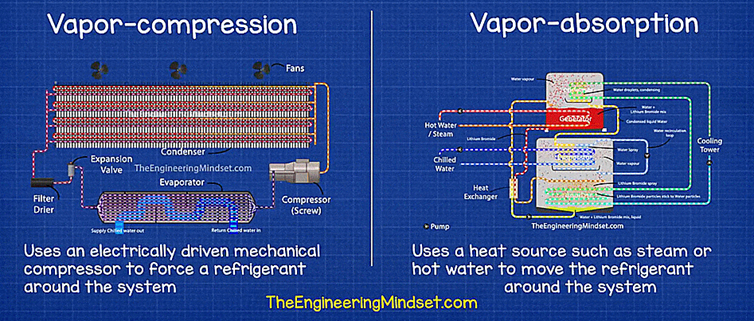
A compression chiller performs cooling based on the compression of refrigerant gas. Compression chillers that operate using electricity have various parts such as: compressor, condenser, evaporator, expansion valve.
In this type of chiller, the gas pressure is first increased by the compressor and then enters the condenser and, by losing heat, turns into a liquid and then enters the evaporator through the expansion valve and reduces the temperature and pressure and takes the heat of the water in the vicinity of the evaporator. As a result, cooled water is produced in the chiller and is used for various purposes, including natural ventilation. In this case, the cold water passes through a closed cycle between the evaporator and the fan coil or air conditioning unit by means of a circulation pump. The condenser is also cooled by water, the heat of which is recovered in the cooling tower. Compression chillers are divided into two general groups in terms of their performance: water compression chillers and air compression chillers.

Absorption chiller
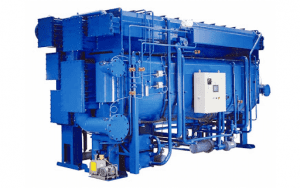
There are different types of absorption chillers, but they all work on a similar principle. In a low-pressure system, an absorbent fluid evaporates and removes heat from the cooled water. A heat source such as steam, exhaust gas, or hot water is used to regenerate the absorption solution.
In an absorption chiller, like a compression chiller, it has an absorber chamber and an evaporator for heat exchange. The absorption chiller also creates cold and reduces the temperature of the coil water by evaporation. We call it the evaporator chamber or evaporator, and we call its pump an evaporator pump or refrigerant pump.
The principle of operation of absorption and compression chillers is the same, except that a different method is used to increase the pressure of the gas exiting the evaporator for the purpose of transferring it to the condenser. After the evaporator, the water vapor is absorbed by a liquid such as lithium bromide. The absorbent liquid solution and water are transferred to the heat generator by a pump. This solution is then heated, causing the dissolved water to evaporate and enter the condenser. The rest of the cycle is the same as the compression cycle.
Waste heat from other sources can be used as a heat generator, which increases efficiency.
Absorption chillers generally have several main components: a generator, a condenser, an absorber, an evaporator, and a heat exchanger.
share :
Related Articles

Lithium Bromide Absorption Chillers: Application, Performance, and Maintenance Challenges
How do lithium bromide absorption chillers work? Why are they suitable for air conditioning systems? A comprehensive guide to their performance, benefits, limitations, and chemical maintenance.

What is an absorption chiller? A comprehensive guide to the operation, benefits and challenges of thermal cooling systems
How does an absorption chiller produce cold with heat? Differences from a compression chiller, chemical challenges and maintenance solutions + analysis of lithium bromide solution.

Signs of the need for cooling tower chemical clean?
Is your cooling tower losing efficiency? Increasing temperatures? Bad odors? In this technical guide, learn 10 surefire signs your cooling tower needs chemical flushing — before irreparable damage occurs.

Types of cooling towers in terms of airflow | natural, mechanical, forced, induced, mixed
With a complete introduction to the 5 types of cooling towers in terms of airflow (natural, mechanical, forced, induced, mixed) and how each operates, choose the best chemical maintenance method to increase the efficiency and life of your equipment.

Power plant cooling system
Thermoelectric power plants boil water to create steam, which then turns turbines to generate electricity. The heat needed to boil the water can come from burning fuel, nuclear reactions, or the sun. As the steam passes through a turbine, it must be cooled back to water before it can be used again to generate more electricity. Colder water cools the steam more effectively, increasing the efficiency of electrical energy generation.

Types of refrigeration systems
Refrigeration is the process of absorbing heat from one fluid and releasing it to another. The fluid can be air, water, or any other gas or liquid. In all refrigeration systems, keeping cool involves absorbing heat from a lower-temperature material and releasing it to a higher-temperature environment.

Sediment investigation in the cooling tower and its control
Cooling towers, as the name suggests, are used for cooling. Equipment used in industry for heat transfer is one of the important equipments, among which cooling towers are effective and practical for the continuation and continuity of operations and other processes.
Submit your opinion
Your email address will not be published.