Condenser
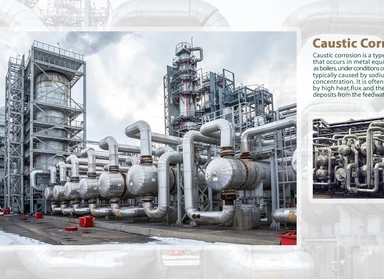
Caustic corrosion
Localized corrosion caused by the concentration of caustic or alkaline salts, which usually occurs under conditions of high evaporation or heat transfer. Caustic salt or caustic soda is one of the most widely used ionic compounds and is used in various industries including water treatment, cardboard and paper production, oil and refinery industries, aluminum production industries, food industries, alcohol production and glass.
What is a chiller?
Chiller is derived from the Latin word Chill, meaning to cool. Various cycles are used to create refrigeration, the most important of which are the compression refrigeration cycle, the absorption refrigeration cycle, and the thermoelectric refrigeration cycle.
Industrial Mitreh (sediment remover and anti-corrosion)
Any system where temperature and water are the main elements for its operation inevitably requires the invention of Abrizan Company, called Industrial Mitreh, because wherever there is temperature and water, the formation of sediment is inevitable, unless a substance is used that suspends these sediments. This is the main function of an excellent anti-sediment solution.
Cold Mitreh
Cold Mitreh, a water-soluble solution with a high dissolution rate, is introduced as a powerful scale remover and an innovative product of Abrizan Company. Cold Mitreh was developed in response to the industry's need for an alternative solution to descalers. Descalers are scale removers based on hydrochloric acid and are highly dangerous, toxic, and corrosive.
Condenser and its types
Condenser: A unit for controlling temperature in refrigerators, air conditioning systems, and chillers. Its main function is as a heat exchanger in which it converts a substance (refrigerant) from a gas state to a liquid state, from where the latent heat is dissipated by the substance and transferred to the condenser coolant.
Types of refrigeration systems
Refrigeration is the process of absorbing heat from one fluid and releasing it to another. The fluid can be air, water, or any other gas or liquid. In all refrigeration systems, keeping cool involves absorbing heat from a lower-temperature material and releasing it to a higher-temperature environment.

Types of heat exchangers in the industry
There are various types of heat exchangers in the industry, examples of which include: double-tube, plate, spiral tube and shell-and-tube heat exchangers, each of which has its own working method. Also, each heat exchanger has its own advantages and disadvantages.