


Water Turbidity Measurement: A Comprehensive Guide for Industry and Drinking Water

Measuring Water Turbidity
Have you ever wondered why tap water should be completely clear? Or why in various industries, even a speck of turbidity in water can cause billions in damages?
The answer to these questions lies in a concept called "water turbidity". Turbidity is not just an apparent problem; it is also a key indicator for health, efficiency and safety in many industrial and water supply processes.
In this article, you will learn in a completely comprehensive and practical way about the concept of water turbidity, its causes, measurement methods, global standards, its negative effects on industrial equipment and ways to reduce it.
What is water turbidity?
Turbidity is a measure of water clarity. The turbider the water, the less light passes through it. This phenomenon occurs due to the presence of suspended particles in water that are not visible to the naked eye, but scatter or absorb light.
These particles can include:
- Soil and clay
- Sludge and organic sediments
- Algae and microorganisms
- Metal particles or chemicals
- Particles from pipe erosion
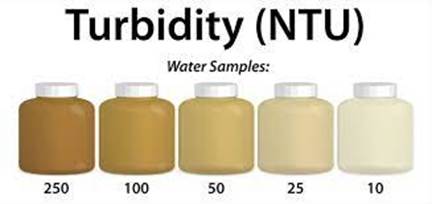
Why is measuring water turbidity important?
Turbidity is not just an aesthetic indicator. In fact, this parameter plays a vital role in the following:
1. Public health
In drinking water, high turbidity can be an indication of the presence of bacteria, viruses or parasites. Suspended particles can act as a haven for pathogenic microbes and reduce the effectiveness of disinfection methods such as chlorination.
2. Efficiency of industrial processes
In industries such as power plants, heating plants, cooling systems and boilers, high turbidity leads to:
- Formation of deposits on the internal surfaces of pipes and heat exchangers
- Reduced heat transfer
- Increased energy consumption
- Corrosion of equipment
3. Compliance with standards
International organizations such as the World Health Organization (WHO) and national standards (such as the Iranian National Standard 1053) have set the maximum permissible turbidity level in drinking water between 0.5 and 1 NTU.
Factors causing turbidity in water
Turbidity can be caused by natural sources or human activities:
- Heavy rainfall: causes soil erosion and the entry of particles into surface water sources.
- Agricultural activities: The use of fertilizers and irrigation can transfer fine particles into rivers.
- Industrial effluents: Some industries return turbid water to the environment without adequate treatment.
- Erosion of old pipes: In urban water supply systems, rust and decay of pipes introduce metal particles into the water.
Methods for measuring water turbidity
Turbidity is measured accurately and in a standardized manner. The most common methods are:
Nephelometric Method
This method is the international standard and is based on light scattering at a 90-degree angle. The device used is called a turbidimeter.
- Unit of measurement: NTU (Nephelometric Turbidity Unit)
- High accuracy, suitable for laboratories and industry
Jackson Candle Method
An older method that uses a candle and a glass tube to measure the depth at which the candlelight is not visible.
- Unit: JTU (Jackson Turbidity Unit)
- Less used today
Other methods
- Formazin method: Using a standard Formazin solution to calibrate devices
- Optical method with smart sensors: In industrial online monitoring systems
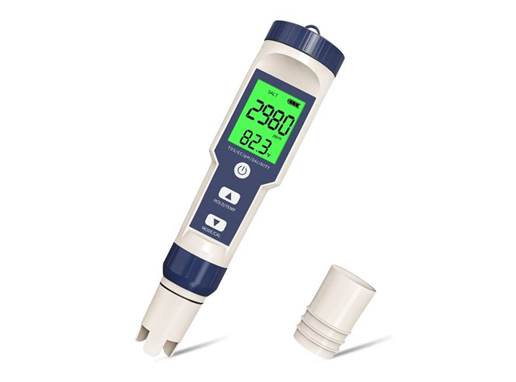
Turbidimeter for accurate measurement of water turbidity
International and national standards for water turbidity
Water type | Maximum permissible turbidity (NTU) | Source |
Drinking water | 0.5 – 1 | WHO, National Standard of Iran |
Industrial water (boiler, chiller) | < 0.1 – 0.5 | ASME، ASTM |
Aquaculture water | < 25 | FAO |
Natural river water | 5 – 100+ | Depending on the season and geographical location |
Note: In industrial water circulation systems (such as cooling towers), even turbidities below 1 NTU can lead to long-term scaling.
Impact of high turbidity on industrial equipment
In industries where water is used as a heat transfer or coolant, high turbidity can cause serious damage:
1. Scaling
Suspended particles gradually settle on the inner surfaces of pipes and exchangers, creating an insulating layer that impairs heat transfer.
2. Increased energy consumption
With reduced heat transfer, systems consume more energy to reach the desired temperature — sometimes by as much as 15 to 20 percent!
3. Under-deposit Corrosion
Deposits can create an acidic or oxygen-deficient environment that causes localized corrosion of metals.
4. Clogging of nozzles and filters
In spray or cooling systems, small particles can clog nozzles and impair system performance.
Ways to Reduce Water Turbidity
Reducing turbidity requires a systematic approach. Common methods include:
1. Coagulation & Flocculation
- Adding chemicals such as alum or polyelectrolytes
- Fine particles become larger and settle more easily
2. Sedimentation
- Flocculated particles settle in tanks due to their greater weight
3. Filtration
- Using sand filters, cartridges, or membranes (such as RO)
- Is effective for removing very fine particles
4. Using online monitoring systems
- Installing turbidity sensors in main lines for early warning
5. Periodic chemical flushing
- In industrial systems, using specialized solutions to clean sediment and accumulated particles
Some chemical washing projects by Abrizan
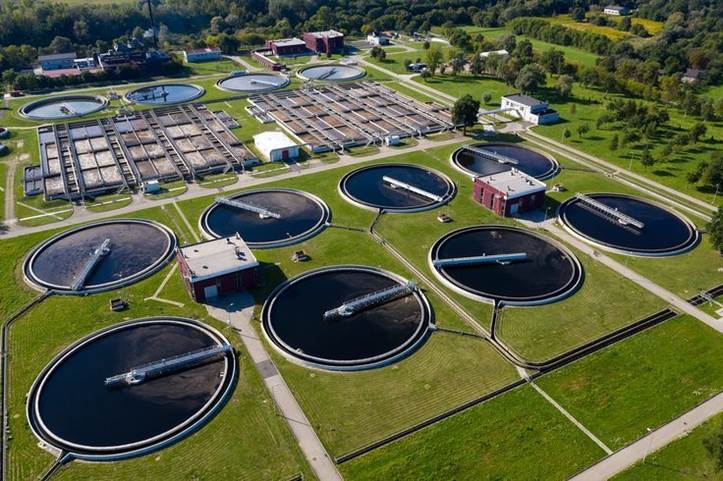
Water turbidity reduction process by flocculation and sedimentation
❓❓❓ Common questions from users about water turbidity ❓❓❓
❓ Is turbid water necessarily contaminated?
Not necessarily. Sometimes air bubbles or dissolved carbonates cause temporary turbidity that disappears after a few minutes. But if the turbidity is persistent, it needs to be investigated.
❓ Do home filters reduce turbidity?
Yes, activated carbon filters or micron cartridges (1 to 5 microns) can remove some of the particles, but for high turbidities, more advanced systems such as RO are needed.
❓ When should water turbidity be measured?
- At the inlet and outlet of treatment plants
- Before and after chemical processes
- In industrial systems: monthly or seasonally
- In case of a change in the color or smell of the water
✅ Conclusion: Water turbidity, a small indicator with a big impact
Water turbidity is not just a number in a laboratory report; Rather, it is a vital indicator of the health, efficiency, and sustainability of water systems. Whether at home or in industry, ignoring this parameter can lead to heavy costs — from increased energy consumption to expensive equipment failure.
If you operate in industry and use water circulation systems, regular turbidity checks and specialized water tests can extend the life of your equipment and prevent damage. Also, if you need detailed water analysis or design chemical maintenance programs, consulting with experts from reputable laboratories can make your decisions smarter.
✅ Our suggestion: Test the water in your industrial systems for turbidity and other key parameters (such as hardness, pH, TDS) every 3 to 6 months.
↩️ Contact us for a free consultation with Abrizan specialists.
share :
Related Articles
International standards for maintaining and cleaning desalination plants
Do you know what international standards are required for the maintenance and cleaning of desalination plants? A complete guide to extending the life of equipment and preventing sedimentation.

Types of deposits and corrosion in MED desalination water
Types of deposits and corrosion in MED desalination plants — calcium carbonate, sulfate, silica, magnesium hydroxide, subsedimentary corrosion. Accurate detection methods with XRD, SEM, ICP. Specialized solutions for water treatment plants with (Mitreh brand).
Why is it important to control sedimentation and corrosion in desalination devices؟
Why is scale and corrosion control vital in desalination plants? A technical and economic analysis of the impact of scale and corrosion on equipment performance, cost, and life. Warning signs and preventive measures. Suitable for engineers and industrial managers

Comparison of RO, MED, MSF desalination water in terms of cost, energy consumption, chemical requirement of the industry
Detailed comparison of RO, MED, MSF in terms of cost, energy consumption and chemical requirements. Technical analysis, comparison table and decision-making guide. MED with recycled heat is cheaper than RO! Suitable for engineers and industrial managers

MVC desalination plant (Mechanical vapor compression)
MVC (Mechanical Vapor Compression) Desalination — Comprehensive Guide to Application, Advantages, Disadvantages and Chemical Solutions by Abrizan Company (Mitreh Brand). Evaporator Chemical Washing, Thermal Anti-Fouling, Laboratory Consulting. Increase Efficiency — Reduce Energy Costs
EDI desalination plant (Electrodialysis)
EDI (Electrodialysis) Desalination — A Comprehensive Guide to Technology, Applications, Advantages and Disadvantages. Ultrapure Water Production Without Regeneration Chemicals. Applications in Pharmaceutical, Semiconductor and Power Plants. Pretreatment Requirements and Technical Challenges
MSF Desalination Plant (Multi-Stage Flash)
MSF (Multi-Stage Flash) Desalination Plant — Comprehensive Guide to Sediment and Corrosion Control with Solutions from Abrizan Company (Mitreh Brand). Specialized Chemical Washing, Anti-Sediment and Thermal Anti-Corrosion, Laboratory Consulting. Increased Efficiency — Reduced Energy Costs — Increased Equipment Life.
MED water desalination plant
MED (Multiple Effect Distillation) Desalination Plant — Comprehensive Guide to Chemical Requirements, Sediment and Corrosion Control with Solutions from Abrizan Company (Mitreh Brand). Specialized Chemical Washing, Thermal Anti-Sedimentation, Laboratory Consulting, Increased Efficiency — Reduced Energy Costs
Submit your opinion
Your email address will not be published.