


Warning signs of the need for boiler chemical washing

Scaling in Boilers is Like a Heart Attack: It Progresses Silently, But the Final Blow Can Cost Hundreds of Millions.
In this comprehensive guide, we will introduce all the warning signs of scaling in boilers, from increased tube temperature to fluctuations in water level. We’ll also explain the difference between anti-scaling and descaling agents, teach you a step-by-step chemical cleaning process, and compare boiler repair costs due to scaling with prevention costs. This way, you can make the best decision to maintain your system with full awareness.
Why Read This Article?
✅ Identify 5 dangerous signs of scaling in boilers before damage occurs.
✅ Understand the difference between anti-scaling agents and descalers — and make an informed choice based on your system's needs.
✅ Learn the step-by-step chemical cleaning method for boilers — safe and effective.
✅ Receive an immediate checklist for quick scaling detection.
✅ Compare repair costs vs. prevention costs with comparative figures.
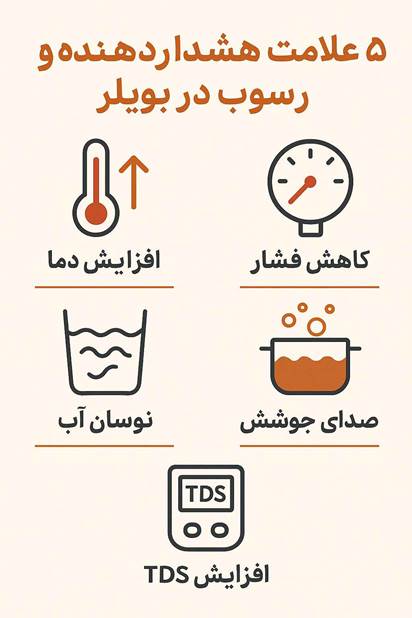
What are the signs and symptoms of boiler scale?
Scale in a boiler usually progresses silently and gradually, but its symptoms are clearly visible in the operating parameters. Here are 5 key warning signs:
1. Increased Tube Wall Temperature
- → Why does it happen? Scale forms an insulating layer on the inner surface of the tubes → heat transfer decreases → metal temperature increases.
- Danger :High metal temperature → metallurgical structure changes → cracking → pipe rupture!
- Diagnosis :Temperature monitoring with thermocouple — increase of more than 20°C from normal conditions = red alert!
2. Steam Pressure Drop
- → Why does it happen? Scale reduces heat transfer → reduced steam production → reduced pressure in the steam line.
- Danger :Reduced production capacity — process stoppage — economic losses.
- Diagnosis :10-15% decrease in steam pressure at steady state = need to check for scale.
3. Water Level Fluctuation in Drum
- → Why does it happen? Scale causes irregular boiling (Foaming & Priming) → Production of large bubbles → Water level fluctuation.
- Danger :Safety valves malfunction — Boiler runs dry!
- Diagnosis : Abnormal water level fluctuation in glass gauge or level control system.
4. Abnormal Boiling Noise
- → Why does it happen? Intense local boiling under the scale layer → Creating a “tapping” or “buzzing” sound.
- Danger :Local metal destruction — Fatigue cracks start.
- Diagnosis :Listening with an industrial stethoscope or microphone — Abnormal sound = immediate warning.
5. High TDS in Feedwater and Drum Water
- → Why does it happen? Scale formation → Reduced heat transfer surface area → Increased salt concentration in drum water.
- Danger :Irregular boiling — Alkaline corrosion — More scale formation!
- Diagnosis :Weekly TDS analysis — Increases over 3000 ppm in low pressure boilers = need to be flushed.
What is the difference between anti-scale and boiler scale remover? Which should I choose?
Many confuse the two — but the difference is crucial:
Parameter | Anti-scaling (Antiscalant) | Descaler |
Application | Prevention — Prevents new scale formation | Treatment — Removes existing scales |
Usage Time | Continuous — in the boiler feedwater | Periodic — during chemical cleaning |
Mechanism | Alters the crystalline structure of salts — keeps particles suspended | Chemically dissolves scale layers (acidic or chelating) |
Main Ingredients | Polyphosphate, polyacrylate, phosphonate | Citric acid, sulfamic acid, EDTA, HEDP |
Risks | Low — if dosed correctly | High — if chosen or applied incorrectly → Metal corrosion |
Cost | Low — continuous use but low dosage | High — periodic use but high dosage |
✅ Selection summary:
- If your boiler is clean and you want to prevent → Anti-scale
- If your boiler is scaled and needs cleaning → Scale remover
- Combination of both: continuous use of anti-scale + periodic flushing with scale remover = the best strategy!
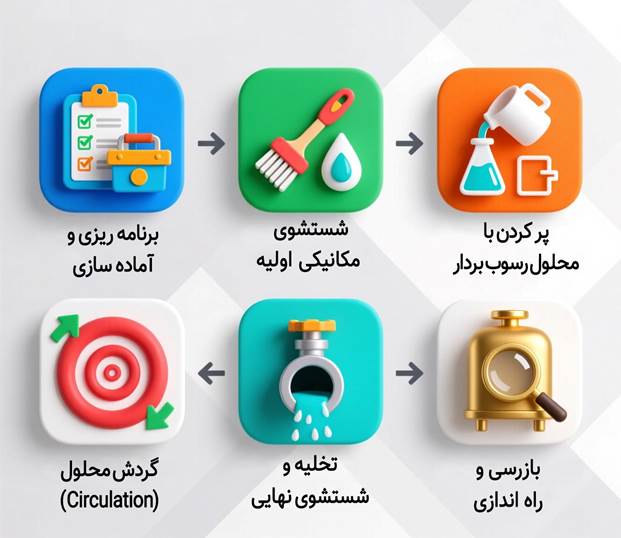
How to flush and clean the boiler from scale (Step by Step)
Chemical flushing of the boiler is a sensitive process. If performed incorrectly, it can cause corrosion and leaks instead of cleaning. Here we will teach you the standard step-by-step procedure:
✅ Step 1: Planning and preparation
- Shut off water and steam inlet
- Cool the boiler to below 40°C
- Drain the drum water
- Take a sample of scale for analysis (optional — but recommended)
✅ Step 2: Initial mechanical cleaning
- Open the valves and access the pipes
- Remove thick layers of scale with a drill or brush (if possible)
✅ Step 3: Fill with scale remover solution
- Spray or pump the scale remover solution (e.g. 2-5% citric acid + corrosion inhibitor)
- Solution pH: 2.5 to 3.5 (depending on the type of scale and metal)
✅ Step 4: Circulation
- Circulation of the solution with a circulation pump — for 4 to 8 hours
- Continuous pH and temperature control (temperatures above 60°C are not recommended)
✅ Step 5: Drain and final rinse
- Discharge the solution Rinsing
- Repeated rinsing with clean water until pH is neutral
- Final rinsing with neutralizing solution (e.g. 0.5% sodium hydroxide)
✅ Step 6: Inspection and commissioning
- Visual inspection and with an endoscope camera
- Refilling with feed water + anti-scale agent
- Gradual commissioning and monitoring of parameters
Warning:
- Never use hydrochloric acid (HCl) in steel boilers — severe corrosion risk!
- Be sure to use a corrosion inhibitor in the rinsing solution.
- If you do not have sufficient expertise, leave the rinsing to specialist teams.
- We recommend leaving the rinsing to specialist teams.
How much does it cost to repair a boiler due to scale? (Compared to the cost of prevention)
Note:Costs are comparative. (To state the cost of prevention, it is much lower than the direct cost of repair)
Direct repair costs:
- Replacing torn pipes: 50 to 200 million Tomans (depending on the size of the boiler)
- Stopping production: 100 to 500 million Tomans per day (in large industries)
- Emergency washing: 50 to 150 million Tomans (with strong and dangerous substances)
- Cost of inspection and NDT tests: 20 to 50 million Tomans
Prevention costs (periodic washing + anti-scaling):
- Scheduled washing every 6 months: 30 to 80 million Tomans
- Monthly anti-scaling injection: 5 to 15 million Tomans per year
- Total prevention costs per year: 40 to 100 million Tomans
✅ Economic summary:
- Emergency repair costs: 200 to 700+ million Tomans
- Annual prevention costs: 40 to 100 million Tomans
- Annual savings: 100 to 600+ million Tomans!
Real example:
In a 50 ton/hour boiler in a southern refinery, failure to flush in a timely manner resulted in 3 pipe ruptures — Repair + shutdown cost: 480 million Tomans.
Annual periodic flushing cost: 75 million Tomans — Savings: 405 million Tomans!
Quick checklist — Does your boiler need flushing?
Assess the condition of your boiler in 30 seconds with this checklist:
✅ Has the temperature of the pipe walls increased by more than 20°C above the standard?
✅ Has the steam pressure decreased by 10-15% under steady-state conditions?
✅ Does the water level in the drum fluctuate abnormally?
✅ Is there a “tapping” or “buzzing” sound coming from the boiler body?
✅ Has the TDS of the drum water exceeded 3000 ppm (in low-pressure boilers)?
✅ Has it been more than 6 months since the last chemical flushing?
If you answered “yes” to 2 or more of these questions, your boiler needs immediate chemical cleaning!
Practical solution: Abrizan Industrial Research Company — Expertise in Boiler Chemical Cleaning
If you are looking for a smart, scientific and practical solution for cleaning your boiler, Abrizan Industrial Research Company, with years of experience in the water and steam industries, is ready to be by your side.
1. Specialized laboratory — Accurate detection of the type of scale
- Send a scale sample → XRD, SEM analysis, etc. → Accurate detection of the composition (carbonate? sulfate? silica?)
- Proposal of a proprietary Mitreh formulation — not a generic product!
2. Specialized Mitreh brand products
- Special anti-scaling and anti-corrosion for high-pressure boilers
- Special anti-scaling and anti-corrosion for medium and low-pressure boilers
- Special anti-corrosion for the vapor phase of boilers
- Special anti-scaling and anti-corrosion for hot and cold water boilers
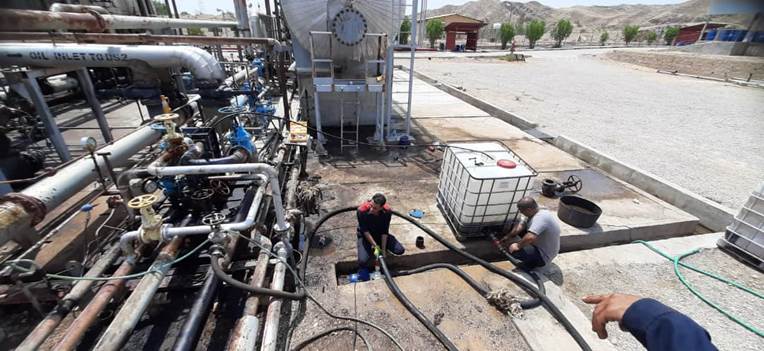
3. Field chemical cleaning services
- Presence of a specialist team on site
- Implementation of a standard protocol with pH, temperature, time control
- Performance report before and after cleaning
4. Free expert advice
- Send operational data → Suggest a solution
- Send free sample + manual
[Request free technical advice and analysis and contact a sales expert directly]
✅ Final Conclusion:
Scaling in the boiler is a silent enemy, but its warning signs are quite clear. With timely detection, the right choice of chemicals and the implementation of periodic washing, you can avoid heavy repair costs, production stoppages and safety hazards.
Abrizan Industrial Research Company with the Mitreh brand, relying on a specialized laboratory, formulated products and a professional executive team, is ready to increase the efficiency of your boiler, reduce operating costs and increase the life of the equipment by up to 2 times.
share :
Related Articles

Chemical vs. Mechanical Washing in MED: Which Method is Better?
Which method is better for cleaning MED devices? Technical comparison, cost and risk of chemical vs. mechanical cleaning.
When is the best time to thermal desalination plant washing?
Signs of need for thermal desalination plant flushing (MED/MSF) + Data-based decision-making guide.
Common challenges in desalination plant maintenance and practical solutions
6 key challenges in power plant desalination plant maintenance + practical solutions to prevent power generation outages.
Types of deposits and corrosion in heat exchangers and identification methods
A comprehensive guide to identifying calcium carbonate, sulfate, silica, iron oxide, and MIC corrosion deposits in heat exchangers using XRD and SEM methods.
Step-by-step guide to chemical boiler cleaning — professional and safe execution
Step-by-step guide to chemical boiler cleaning in compliance with ASME standards, from system shutdown to final passivation. Safe and effective execution.
Warning signs that indicate the need for chemical cleaning of the heat exchanger
Has your heat exchanger lost its efficiency? 5 warning signs (increasing temperature, decreasing ΔT, high pressure, leakage, bad smell) + quick diagnosis checklist.

Comparison of boiler cleaning methods — chemical, mechanical or hydrojet
Which boiler cleaning method is best for you? A complete comparison of chemical, mechanical, and hydrojet methods in terms of cost, safety, time, and efficiency.

Signs of Needing Chemical Backwashing of RO Water Desalination — How to Know if an RO System is "Breathing"?
Is your RO system experiencing reduced water production, increased pressure, or reduced water quality? In this comprehensive article, we explore the 10 warning signs that your RO needs chemical flushing, with technical details, industry statistics, and practical guidance. Free consultation + free sediment sample analysis from your sink.
Submit your opinion
Your email address will not be published.