
Corrosion comparison: Mitreh Cold scale remover solution (MDA0102) vs. hydrochloric acid
1404/08/24
What is the Langelier Index? A Complete Guide to Predicting Water Sedimentation and Corrosion
1404/08/21
Measuring Carbonate and Bicarbonate in Water: A Complete Guide to Alkalinity Control
1404/08/19
Warning signs that indicate the need for chemical cleaning of the heat exchanger
1404/08/17
Comprehensive guide to types of water desalination devices

Choosing a desalination plant is half the battle. The other half is proper chemical management.
In this comprehensive guide, we’ll explore the different types of industrial desalination plants in simple, practical language — without going into heavy technical details (which we’ll explore in more depth in separate articles). Our goal is to help you make an informed choice that’s best for your industry.
In this article you will read:
✅ A simple and practical comparison of the 5 main types of water desalination
✅ Identify the chemical challenges of each system (sedimentation, corrosion, clogging)
✅ A selection guide based on industry, budget and required water quality
Types of water desalination
- RO (Reverse Osmosis) water desalination
- MED (Multi-Effect Distillation) water desalination
- MSF (Multi-Stage Flash) water desalination
- EDI (Electrodeionization) water desalination
- MVC (Mechanical Vapor Compression) water desalination
RO (Reverse Osmosis) water desalination — the most widely used method in the industry
Simple method:
They pass salt water through a semi-permeable membrane at high pressure. Salts and contaminants remain behind the membrane and fresh water comes out the other side.
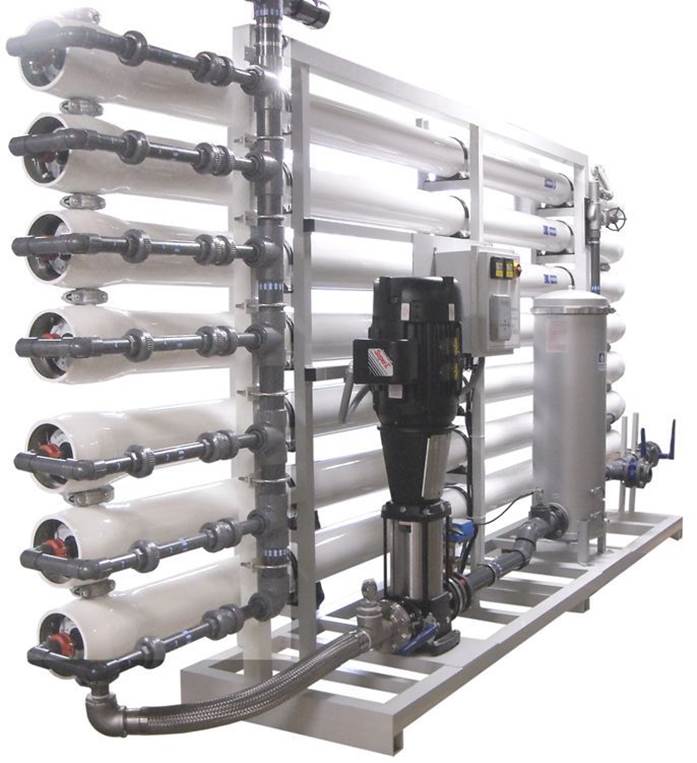
RO water desalination machine
RO Advantages:
- Suitable for all industries — from small to very large
- Relatively low energy consumption
- Advanced and reliable technology
- Possibility of combining with other systems (such as EDI for ultrapure water)
Chemical Challenges of RO:
- Membrane scale (calcium, magnesium, silica) → Reduced flux and water quality
- Biological contamination → Membrane bauxite
- Need for specialized anti-scale and cleaning agents
MED (Multi-Effect Distillation) Desalination Method:
Water is evaporated and condensed in several successive chambers (effects). Each stage uses the heat of the previous stage — so it saves energy.

Industrial MED desalination devices
Advantages of MED desalination:
- Very high outlet water quality (even for pharmaceutical purposes)
- Suitable for connection to power plants (heat recovery)
- High tolerance to fluctuations in inlet water quality
Chemical challenges of MED:
- Deposits in evaporator tubes → Reduced heat transfer
- High temperature corrosion → Need for thermal anti-corrosion
- Need for continuous chemical monitoring
MSF (Multi-Stage Flash) desalination — old but powerful
How MSF desalination works:
Brine water is heated and introduced in successive stages at lower pressure — in each stage, part of the water is converted to steam and converted to fresh water in the condensers.

Advantages of MSF desalination:
- Very high capacity — suitable for large cities and industries
- High reliability — long equipment life
- Usually installed next to thermal power plants
Chemical challenges of MSF desalination:
- Severe corrosion in flash chambers
- Sedimentation in condensers → reduced efficiency
- Requires periodic inspection and washing with specialized chemicals
EDI (Electrodeionization) desalination — for ultrapure water
EDI desalination method:
A combination of ion exchange resins and electric current to produce ultrapure water — no need for acid or base for regeneration.

EDI water desalination machine
Advantages of EDI desalination:
- Producing ultrapure water (UPW) — suitable for pharmaceutical, electronics and laboratory industries
- No regeneration chemicals — environmentally friendly
- Automatic and continuous operation
Chemical challenges of EDI desalination:
- Extreme sensitivity to inlet water quality — requires pretreatment (usually RO)
- Resin fouling in case of suspended particles or silica
- Need to control pH and inlet water hardness
MVC (Mechanical Vapor Compression) desalination — low-power and small
How MVC desalination works:
The steam produced from water evaporation is compressed with a mechanical compressor — and reused as a heat source. Closed and low-energy system.
Advantages of MVC desalination:
- Very low energy consumption — ideal for remote areas
- Suitable for small to medium capacities
- No need for external steam or hot water
Chemical challenges of MVC desalination:
- Scaling in evaporator → Reduced heat transfer
- Corrosion in compressor and pipes → Need for temperature-compatible anti-corrosion protection
- Sensitivity to inlet water hardness
Which desalination system is right for you?
System type | Best use | Energy consumption | Maintenance cost | The main chemical challenge | Outlet water quality |
RO | General industries - refineries, power plants, steel | Down | Medium | Deposition on the membrane | Good to excellent |
MED | Thermal power plants - industries with access to cheap heat | Medium | Top | Deposit + thermal corrosion | Excellent |
MSF | Large urban and industrial projects | Top | Top | Corrosion + scale in condenser | Excellent |
EDI | Pharmaceutical, semiconductor, laboratory industries | Down | Down | Inlet contamination — requires prior RO | Super awesome |
MVC | Remote areas - small industries - limited projects | Very low | Medium | Deposits in the evaporator | Excellent |
Why Chemical Management in Water Desalination = Cost Savings?
Many people think that purchasing a desalination plant is the last expense — but the truth is:
- 70% of the operating costs of desalination plants are related to maintenance, repairs, and replacement of parts — not the plant itself!
Without chemical management, desalination plants:
- Membranes or pipes become fouled → Reduced water production → Increased pressure → Increased energy consumption
- Corrosion causes equipment to puncture → Emergency shutdown → Millions in damage
- Membrane or evaporator replacement → Cost 5 to 10 times more than preventive chemicals!
Specialized services of Abrizan Industrial Research Company (Mitreh brand)
We increase the efficiency of your system.
Free specialized consultation with laboratory support
- Sampling of sediment or incoming water
- Accurate analysis of sediment type (carbonate, sulfate, silicate, etc.)
- Proposal of a proprietary Mitreh formulation — not a generic product!
Field chemical washing by a specialist team
- Presence of the Abrizan team at the project site
- Implementation of washing protocol with parameter control (pH, TDS, TH, temperature, time, flow rate and other required tests)
- Performance report before and after washing
Production of specialized Mitreh solutions
- Sedimentation of acidic and alkaline vectors - for RO, MED, MSF, MVC
- Advanced anti-scaling - prevention of new scale formation
- Thermal and non-thermal anti-corrosion - protection of steel, copper, titanium
- Membrane and resin cleaners - without damage to the equipment structure
All Mitreh products:
- Compliant with API, ASTM, ISO standards
- Adjustable based on system type, inlet water quality and operating conditions
- Available in solution or powder form - with operating manual


Free and Expert Advice — Before Making a Decision!
If you are unsure about choosing the right type of desalination plant or chemicals for it — Abrizan technical experts are ready to help you:
✅ Free analysis of the quality of the incoming water or existing sediment
✅ Proposal of the best Mitreh formulation based on testing
✅ Free sample delivery + manual
✅ On-site chemical washing by a specialist team
Request for free technical advice — with laboratory sampling
Final conclusion:
Choosing the right desalination plant is not just a technical decision — it is an economic and strategic decision. And its chemical management determines the life and efficiency of your system.
Abrizan Industrial Research Company with the Mitreh brand, relying on experience, laboratory and expert executive team, is ready to be by your side.
share :
Corrosion comparison: Mitreh Cold scale remover solution (MDA0102) vs. hydrochloric acid
1404/08/24What is the Langelier Index? A Complete Guide to Predicting Water Sedimentation and Corrosion
1404/08/21Measuring Carbonate and Bicarbonate in Water: A Complete Guide to Alkalinity Control
1404/08/19Warning signs that indicate the need for chemical cleaning of the heat exchanger
1404/08/17
Related Articles
Water Turbidity Measurement: A Comprehensive Guide for Industry and Drinking Water
What is water turbidity? Why is it vital to measure it? Read about measurement methods, standards, and ways to reduce turbidity in this complete guide.

Types of deposits and corrosion in MED desalination water
Types of deposits and corrosion in MED desalination plants — calcium carbonate, sulfate, silica, magnesium hydroxide, subsedimentary corrosion. Accurate detection methods with XRD, SEM, ICP. Specialized solutions for water treatment plants with (Mitreh brand).
Why is it important to control sedimentation and corrosion in desalination devices؟
Why is scale and corrosion control vital in desalination plants? A technical and economic analysis of the impact of scale and corrosion on equipment performance, cost, and life. Warning signs and preventive measures. Suitable for engineers and industrial managers

Comparison of RO, MED, MSF desalination water in terms of cost, energy consumption, chemical requirement of the industry
Detailed comparison of RO, MED, MSF in terms of cost, energy consumption and chemical requirements. Technical analysis, comparison table and decision-making guide. MED with recycled heat is cheaper than RO! Suitable for engineers and industrial managers

MVC desalination plant (Mechanical vapor compression)
MVC (Mechanical Vapor Compression) Desalination — Comprehensive Guide to Application, Advantages, Disadvantages and Chemical Solutions by Abrizan Company (Mitreh Brand). Evaporator Chemical Washing, Thermal Anti-Fouling, Laboratory Consulting. Increase Efficiency — Reduce Energy Costs
EDI desalination plant (Electrodialysis)
EDI (Electrodialysis) Desalination — A Comprehensive Guide to Technology, Applications, Advantages and Disadvantages. Ultrapure Water Production Without Regeneration Chemicals. Applications in Pharmaceutical, Semiconductor and Power Plants. Pretreatment Requirements and Technical Challenges
MSF Desalination Plant (Multi-Stage Flash)
MSF (Multi-Stage Flash) Desalination Plant — Comprehensive Guide to Sediment and Corrosion Control with Solutions from Abrizan Company (Mitreh Brand). Specialized Chemical Washing, Anti-Sediment and Thermal Anti-Corrosion, Laboratory Consulting. Increased Efficiency — Reduced Energy Costs — Increased Equipment Life.
MED water desalination plant
MED (Multiple Effect Distillation) Desalination Plant — Comprehensive Guide to Chemical Requirements, Sediment and Corrosion Control with Solutions from Abrizan Company (Mitreh Brand). Specialized Chemical Washing, Thermal Anti-Sedimentation, Laboratory Consulting, Increased Efficiency — Reduced Energy Costs
Submit your opinion
Your email address will not be published.