


The role of feed water in the performance of desalination and its optimization solutions

Introduction: Thermal Desalination in the Oil and Gas Industry
Why is feedwater quality crucial?
In the oil, gas, refinery, and power plant industries, thermal desalination is a key component in providing pure, salt-free water. These devices convert seawater or brackish water into fresh water through evaporation and distillation, and play a vital role in powering steam generation units, cooling systems, and industrial processes.
In the Persian Gulf region, where access to natural fresh water is limited, thermal desalination, especially the MED (Multi-Effect Distillation) and MSF (Multi-Stage Flash) types, have become the industry’s primary choice. However, the performance of these devices is greatly affected by the quality of the feedwater.
Feedwater—that is, the water entering the system—can quickly lead to scale formation in heater, condenser, and demister tubes if it lacks proper pretreatment or has high concentrations of minerals, silica, iron, or biological contaminants. These deposits not only reduce water production efficiency, but also increase energy consumption and shorten the useful life of the equipment.
In this article, we will examine in detail the role of feedwater in the performance of thermal desalination plants, especially the MED type. We will also present operational and chemical solutions to optimize performance, prevent scaling, and recover lost efficiency. In the meantime, we will also refer to real case studies of projects carried out by companies active in this field — including Abrizan Industrial Research Company.
What is a thermal desalination plant? Types of MED and MSF and their differences
Thermal desalination plants use thermal energy (usually industrial steam) to evaporate salt water and distill its vapor. The two main technologies in this field are MED (Multi-Effect Distillation) and MSF (Multi-Stage Flash).
MED Desalination (Multi-Effect Distillation)
In the MED system, the feed water flows in a layer over the heating tubes. The steam in the tubes evaporates the surface water and the steam produced is transferred to the next effect and acts as a heat source. This process is repeated in several effects and has high efficiency.
Advantages of MED:
- Lower energy consumption than MSF
- Suitable for combination with base energy systems
- Better performance in conditions of medium quality feed water
MSF Desalination (Multi-Stage Evaporation)
In MSF, feed water is pumped under high pressure and temperature into successive chambers (Stage). As the pressure decreases, the water evaporates suddenly (Flash Evaporation). This process is repeated in several stages.
Advantages of MSF:
- Better tolerance of low-quality feed water
- High scalability
- Suitable for large power plants
Both systems are highly dependent on the quality of the feed water, but MED is more sensitive to scale formation due to its larger contact surface and higher operating temperature.
What is feed water in a desalination plant and what are its characteristics?
Feed water is the water entering the desalination system. This water is usually supplied from the following sources:
- The Persian Gulf Sea (the most common source)
- Coastal rivers
- Recycled industrial water
The quality of this water is the main determinant of the lifespan and efficiency of the desalination plant. Key feed water parameters include:
Parameter | Impact |
TDS (Total Dissolved Solids) | Above 40,000 ppm increased risk of sedimentation |
pH | Above 8.5, increased calcium carbonate formation |
Calcium and magnesium | Main factors of hardness and scale formation |
Bicarbonate | Converts to carbonate at high temperatures. |
Silica (SiO₂) | Above 25 ppm risk of hard silicate formation |
Iron and manganese | Nucleus of deposit formation and corrosion |
Total Suspended Solids (TSS) | Clogging of filters and pipes |
Biological contaminants | Biofilm formation and biofouling |
Due to high temperatures, high densities of fish and algae, and industrial pollution, the Persian Gulf Sea contains high concentrations of silica, calcium, and organic matter, which greatly increases the risk of sediment formation.
Effect of Feedwater on MED Desalination Plant Performance
In MED desalination plants, feedwater flows in layers over the heating tubes. Any inhomogeneity in the feedwater quality leads to scale formation on the tube surface.
Increased thermal resistance
Scales act as thermal insulators and impede the transfer of heat from the steam inside the tube to the external feedwater. This leads to:
- Reduced heat transfer coefficient (U-Factor)
- Increased steam temperature required
- Increased energy consumption
Reduced desalination plant product water flow rate
With reduced heat transfer, the evaporation rate decreases and as a result, the flow rate of the produced fresh water decreases.
Increased superheat temperature
To compensate for the reduced heat transfer, the system is forced to increase the steam temperature, which in turn increases the risk of faster scale formation.
Decreased efficiency (GOR)
The most important performance indicator is GOR (Gain Output Ratio). A decrease in GOR directly indicates a loss of efficiency and is often caused by scale due to poor feedwater quality.
Types of Scales Formed in MED Desalination Plants
Scaling in MED desalination plants is one of the most common operational problems. The main types of scale are:
Sediment type | Chemical formula | Formation conditions | Consequence |
Calcium carbonate | CaCO₃ | High temperature, pH>8.5 | Surface scale, reducing heat transfer |
Calcium sulfate | CaSO₄ | High concentration, evaporation | Hard sediment and difficult to remove |
Calcium silicate | CaSiO₃ | SiO₂> 25 ppm | Very sticky and resistant deposit |
Iron oxide | Fe₂O₃ | Pipe corrosion | Sediment formation nucleus |
Biofouling | Biofilm | Biological contamination | Reduced flow rate, localized corrosion |
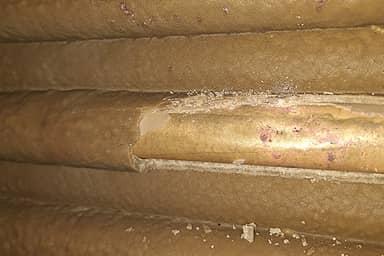
Sample of sediment in desalination heater pipes
Consequences of scale formation in thermal desalination plants
Scaling formation is not only a technical problem, but also leads to operating costs, production downtime and reduced equipment life.
- Reduction in GOR by up to 40% in severe cases
- Increase in steam consumption by up to 25%
- Need to stop production for washing or scale removal
- Increase in pressure and risk of pipe burst
- Reduces equipment useful life by up to 50%
- Increases maintenance and repair costs
Problems caused by scale formation in the facility
Desalination plant key performance indicators (KPIs)
To evaluate performance, key indicators should be monitored:
Index | Definition | Normal value (MED) | The effect of feed water |
GOR | Ratio of steam produced to steam consumed | 6 to 12 | Decrease with increasing sediment |
PR | Ratio of produced water to incoming water | 0/8 to 1/2 | Decrease with increasing TDS |
LMTD | Logarithmic mean temperature difference | > °C5 | Increase with decreasing heat transfer |
Specific Heat Consumption | Energy consumption per ton of water | 150>kWh/m³ | Increase in poor water quality |
Solutions to optimize desalination performance
Pre-treatment of feed water
- Multilayer filtration (sand, activated carbon, silica)
- Cartridge filter (5 microns)
- Reverse osmosis before MED (50-70% TDS reduction)
- Chlorination and dechlorination to control biofouling
Read about the feed water treatment process for industrial boilers and power plants
Use of specialized chemicals
- Antiscalant: Prevents calcium and sulfate crystallization
- Dispersant: Disperses sediment particles
- Anticorrosion: Protects steel pipes
- Oxygen scavenger: Reduces oxygen corrosion
Periodic washing with chemical solutions
- Every 3 to 6 months based on operating conditions
- Detection of washing time: GOR drop > 15%, steam temperature increase > 5°C
- Use of non-acidic and anti-corrosion solutions
Case study: Improving MED desalination performance with chemical washing
- Before washing: GOR = 2.1
- After washing with specialized Mitreh solution: GOR = 5.4 (+157%)
- Recovery of 85% of production capacity (40% increase compared to the previous situation)
- Complete cleaning of the space between the tubes from hard deposits
- Reduction of steam consumption
- No need for long production stops
Desalination of desalination water (12th refinery, South Pars Gas Complex)

Image before sedimentation
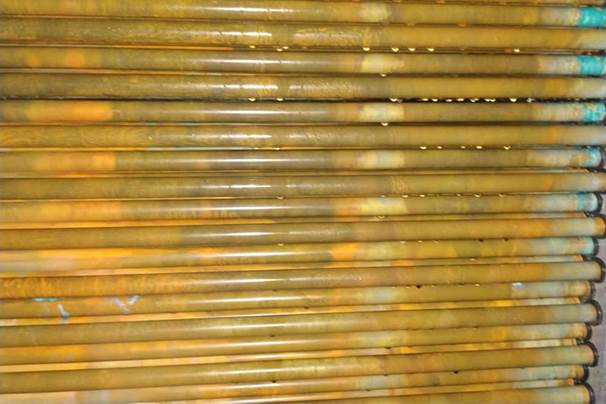
Image after chemical washing with Mitreh solution
Basic scale removal with specialized solutions
- For cases where the space between the pipes is completely blocked
- Use of non-acidic, emulsion and anti-corrosion solutions
- Operation performed by a specialist team
Read about why is it necessary to control scale and corrosion in desalination plants?
Case study: Scale removal at the Seventh Refinery of South Pars
- The pipes of the device were completely filled with scale
- Scaling removal with cold mitreh solution by the specialist team of Abrizan Company
- A significant volume of carbonate and silicate scale was removed
- Result: GOR returned to normal, water flow rate increased by 40%, production stoppage was prevented
Chemical washing of MED desalination plant, Seventh Refinery, South Pars Gas Complex

Image before sedimentation
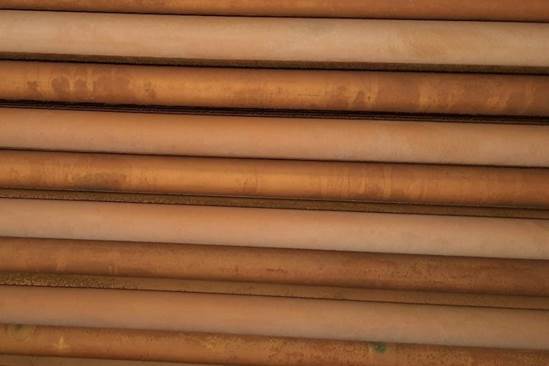
After sedimentation, the desalination water is mixed with the solution.
Feedwater Monitoring and Control
- Routine Analysis: pH, TDS, Hardness, SiO₂, Fe
- Use of Online Analyzer
- Early Warning for Scale Formation
Summary and Operational Recommendations
- Feedwater quality is the main factor determining the efficiency of the desalination plant.
- Proper pretreatment and the use of specialized chemicals can prevent scale formation.
- Periodic flushing and basic scale removal with specialized solutions (such as Mitreh) is an effective solution to restore efficiency.
- Continuous monitoring and a preventive maintenance program are essential.
- Performing these operations by specialized teams (such as Abrizan Company) ensures the quality and safety of the operation.
Reliable Sources
1. API Standard 650 – Welded Tanks for Oil Storage
2. NACE SP0106 – Internal Corrosion of Oil and Gas Production Equipment
3. ASME Power Conference Papers on MED Efficiency
4. El-Sayed, Y. (2002). *The Thermodynamics of Desalination*.
5. ScienceDirect: "Fouling in Multi-Effect Desalination Plants"
6. Internal Reports of Abrizan Industrial Research Company (Projects carried out with Mitreh solution)
share :
Related Articles
International standards for maintaining and cleaning desalination plants
Do you know what international standards are required for the maintenance and cleaning of desalination plants? A complete guide to extending the life of equipment and preventing sedimentation.
Water Turbidity Measurement: A Comprehensive Guide for Industry and Drinking Water
What is water turbidity? Why is it vital to measure it? Read about measurement methods, standards, and ways to reduce turbidity in this complete guide.

Types of deposits and corrosion in MED desalination water
Types of deposits and corrosion in MED desalination plants — calcium carbonate, sulfate, silica, magnesium hydroxide, subsedimentary corrosion. Accurate detection methods with XRD, SEM, ICP. Specialized solutions for water treatment plants with (Mitreh brand).
Why is it important to control sedimentation and corrosion in desalination devices؟
Why is scale and corrosion control vital in desalination plants? A technical and economic analysis of the impact of scale and corrosion on equipment performance, cost, and life. Warning signs and preventive measures. Suitable for engineers and industrial managers

Comparison of RO, MED, MSF desalination water in terms of cost, energy consumption, chemical requirement of the industry
Detailed comparison of RO, MED, MSF in terms of cost, energy consumption and chemical requirements. Technical analysis, comparison table and decision-making guide. MED with recycled heat is cheaper than RO! Suitable for engineers and industrial managers

MVC desalination plant (Mechanical vapor compression)
MVC (Mechanical Vapor Compression) Desalination — Comprehensive Guide to Application, Advantages, Disadvantages and Chemical Solutions by Abrizan Company (Mitreh Brand). Evaporator Chemical Washing, Thermal Anti-Fouling, Laboratory Consulting. Increase Efficiency — Reduce Energy Costs
EDI desalination plant (Electrodialysis)
EDI (Electrodialysis) Desalination — A Comprehensive Guide to Technology, Applications, Advantages and Disadvantages. Ultrapure Water Production Without Regeneration Chemicals. Applications in Pharmaceutical, Semiconductor and Power Plants. Pretreatment Requirements and Technical Challenges
MSF Desalination Plant (Multi-Stage Flash)
MSF (Multi-Stage Flash) Desalination Plant — Comprehensive Guide to Sediment and Corrosion Control with Solutions from Abrizan Company (Mitreh Brand). Specialized Chemical Washing, Anti-Sediment and Thermal Anti-Corrosion, Laboratory Consulting. Increased Efficiency — Reduced Energy Costs — Increased Equipment Life.
Submit your opinion
Your email address will not be published.