


Why is it important to control sedimentation and corrosion in desalination devices؟

A 1mm layer of scale can increase your desalination plant's energy consumption by 15%, and invisible corrosion can cost millions of dollars in 6 months.
In this article, we will scientifically and practically examine why scale and corrosion control in desalination plants - whether RO, MED, or MSF - is not an option, but a vital necessity.
This article is based on real data from industrial projects, international technical reports, and economic analyses - so that you can be fully informed and avoid unnecessary costs, production downtime, and irreparable damage.
Why read this article?
✅ A deep understanding of the impact of scale and corrosion on desalination plant performance
✅ Learn about the hidden costs of neglecting chemical control
✅ Identify warning signs before serious damage occurs
✅ Get preventive and operational solutions to extend the life of your equipment
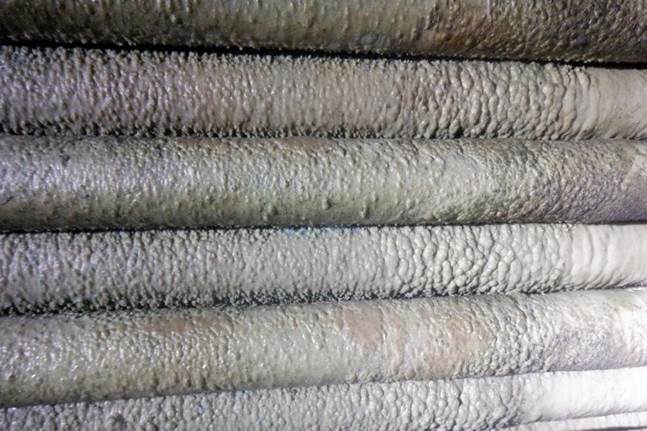
Scale on desalination pipes
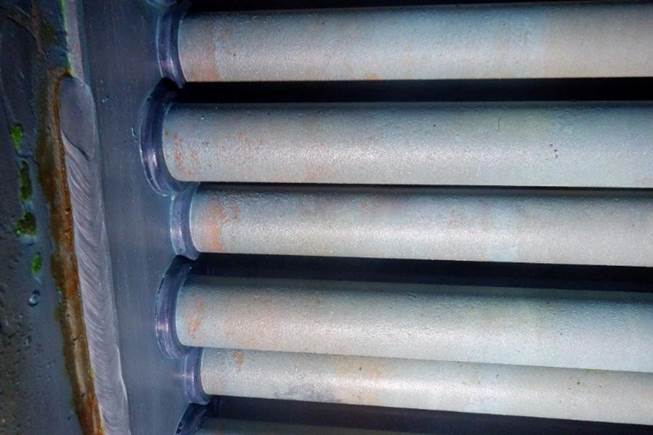
After sediment removal and increased efficiency
Scaling and Corrosion — The Two Main Enemies of Water Desalination
Scaling
The formation of hard, insulating layers of minerals (calcium, magnesium, silica, sulfates) on heat transfer surfaces or membranes.
Corrosion
The destruction of metals (steel, copper, titanium) due to chemical reactions with water, oxygen, chlorides, or improper pH.
Both phenomena progress slowly and invisibly, but their effects are sudden, expensive, and sometimes irreversible.
Effect of scale on desalination performance
In thermal desalination (MED, MSF):
- Scaling on evaporator tubes and condensers → reduces their performance as heat exchangers
- Each millimeter of scale layer → increases 10 to 15% energy consumption
- Reduces heat transfer → increases operating temperature → reduces equipment life
In membrane desalination (RO, NF):
- Scaling on membranes → reduces water flow (Permeate Flow) → increases operating pressure
- Increases pressure → increases electricity consumption by up to 20%
- Reduces outlet water quality → increases TDS → needs to stop and wash
Real example
In an RO project in southern Iran, scaling of membranes after 8 months without anti-scaling caused a 30% reduction in water flow and an increase in electricity consumption by 25% — the cost of emergency washing became very high.
Corrosion Impact — From Leakage to Complete System Shutdown
In Thermal Desalination Plants:
- Corrosion in Flash Chambers (MSF) or Evaporation Tubes (MED) → Saltwater Leakage into Freshwater Chamber
- Effluent Contamination → System Shutdown → Power Plant or Refinery Production Shutdown
- Replacing Corroded Parts → 5 to 10 Times More Expensive Than Chemical Prevention
In Membrane Desalination Plants:
- Corrosion in Steel Fittings or Tanks → Leakage → Safety and Environmental Hazard
- Metal Particles Ingress into Membranes → Permanent Fouling → Need for Membrane Replacement
Industry Statistics:
According to the IDA (International Desalination Association), 40% of unplanned shutdowns in desalination plants are due to corrosion or scale.
Hidden Costs — Why Ignoring Scale and Corrosion Is So Expensive?
Cost | No chemical control | With chemical control |
Energy consumption | Increase by 15 to 30% | Optimal — no unnecessary increases |
Replacing parts | Membrane/tube/chamber replacement High cost | Long equipment life Low cost |
Production stoppage | Emergency stop Millions in damages | Continuous operation No interruptions |
Emergency wash | Expensive cleaning with strong substances Risk of damage | Scheduled wash Controlled |
Environmental cost | Disposal of strong chemical waste Fine | Use of compatible materials Reduce pollution |
Economic Summary
Chemical control costs (anti-fouling + anti-corrosion) are usually less than 3% of the total operating cost. But it saves 30-70% of maintenance and energy costs.
Warning Signs — When to Act?
For RO Desalination water:
- Increased inlet pressure to membranes (+10%)
- Reduced effluent flow (-15%)
- Increased effluent TDS
- Unpleasant odor or algae growth in tanks
For MED/MSF Desalination:
- Increased operating temperature in Brine Heater
- Reduced fresh water production
- Increased steam or energy consumption
- Leaks in joints or welds
- Unusual vibration or noise in pipes
Golden Tip: Don’t wait until the system stops working! Periodic flushing and anti-fouling/anti-corrosion injections are the only way to prevent major damage.
Preventive Strategies — How to Prevent Fouling and Corrosion?
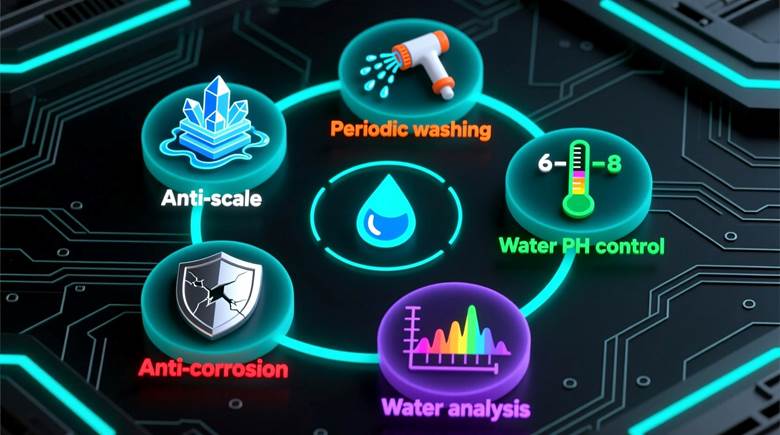
1. Use of antiscalant
- Prevents the formation of calcium carbonate, calcium sulfate, silica, etc.
- Suitable for RO, MED, MSF - with a formulation appropriate to the type of system
2. Anti-corrosion injection
- Protects steel, copper, titanium against acid, alkali and galvanic corrosion
- Essential in thermal systems with the presence of chloride
3. Control of pH and alkalinity of water
- Prevents the formation of scale at high pH
- Prevents corrosion at low pH
- Use buffering agents to keep the pH constant
4. Periodic chemical washing
- Removes old deposits before creating a permanent layer
- Use acid/alkaline washing agents appropriate to the type of deposit and metal
5. Continuous monitoring and water analysis
- Periodic analysis of inlet and effluent water
- Monitoring of operating parameters (pressure, temperature, flux, TDS)
- Data logging to predict the need for washing or adjusting chemicals
A practical solution for controlling scale and corrosion in desalination plants
If you are looking for a smart, scientific and practical solution to control scale and corrosion in your desalination plants, Abrizan Industrial Research Company, with years of experience in the water and process industries, is ready to be by your side.
Accurate diagnosis of scale and corrosion types in a specialized laboratory
Before taking any action, simply send your scale or inlet water sample to Abrizan's well-equipped laboratory. Using advanced methods such as:
- XRD (X-ray diffraction) — to identify the mineral composition of the scale
- SEM-EDS (Electron Microscope + Elemental Analysis) — to identify the structure and composition of the scale or corrosion
- ICP-OES — to accurately analyze the concentration of ions in water
Abrizan's technical team provides the most accurate diagnosis and, accordingly, designs a specific formulation for your system.
Why is this important?
Each scale (calcium carbonate, calcium sulfate, silica, magnesium hydroxide) requires a different scale vector and each type of corrosion (acidic, alkaline, galvanic) requires a specific anti-corrosion agent.
Guessing the type of chemical = wasted money + risk of damage to equipment.
Abrizan Company, under the Mitreh brand, produces specialized chemical solutions for all types of desalination plants:
All Mitreh products:
- Comply with API, ASTM, ISO, NACE standards
- Adjustable based on system type, inlet water quality and operating conditions
- No damage to metals, membranes and the environment
Field chemical washing services — Professional execution at the project site
Our expert executive team:
- Comes to your project site
- Implements the washing protocol with precise control of pH, temperature, time and flow rate
- Records and reports pre- and post-washing parameters
- Provides operational training to your operators
Result: 30 to 50% increase in efficiency — 20 to 35% reduction in energy consumption — Increases equipment life
Free expert advice before purchase or implementation
Just contact our technical experts or send your sediment/water sample to:
- Detect the type of sediment or corrosion
- Suggest the best Mitreh formulation
- Provide accurate dosage and washing schedule
- Free samples and We will provide you with a manual
[Request free technical advice and analysis and contact an expert directly]

Bottom line:
Fouling and corrosion control in desalination plants is a smart investment — not an additional expense. For a small amount of money compared to your total operating cost, you can avoid increased energy consumption, production downtime, expensive parts replacements, and environmental damage.
This article is your guide to understanding the risks, recognizing the symptoms, and implementing preventative measures.
share :
Related Articles
International standards for maintaining and cleaning desalination plants
Do you know what international standards are required for the maintenance and cleaning of desalination plants? A complete guide to extending the life of equipment and preventing sedimentation.
Water Turbidity Measurement: A Comprehensive Guide for Industry and Drinking Water
What is water turbidity? Why is it vital to measure it? Read about measurement methods, standards, and ways to reduce turbidity in this complete guide.

Types of deposits and corrosion in MED desalination water
Types of deposits and corrosion in MED desalination plants — calcium carbonate, sulfate, silica, magnesium hydroxide, subsedimentary corrosion. Accurate detection methods with XRD, SEM, ICP. Specialized solutions for water treatment plants with (Mitreh brand).

Comparison of RO, MED, MSF desalination water in terms of cost, energy consumption, chemical requirement of the industry
Detailed comparison of RO, MED, MSF in terms of cost, energy consumption and chemical requirements. Technical analysis, comparison table and decision-making guide. MED with recycled heat is cheaper than RO! Suitable for engineers and industrial managers

MVC desalination plant (Mechanical vapor compression)
MVC (Mechanical Vapor Compression) Desalination — Comprehensive Guide to Application, Advantages, Disadvantages and Chemical Solutions by Abrizan Company (Mitreh Brand). Evaporator Chemical Washing, Thermal Anti-Fouling, Laboratory Consulting. Increase Efficiency — Reduce Energy Costs
EDI desalination plant (Electrodialysis)
EDI (Electrodialysis) Desalination — A Comprehensive Guide to Technology, Applications, Advantages and Disadvantages. Ultrapure Water Production Without Regeneration Chemicals. Applications in Pharmaceutical, Semiconductor and Power Plants. Pretreatment Requirements and Technical Challenges
MSF Desalination Plant (Multi-Stage Flash)
MSF (Multi-Stage Flash) Desalination Plant — Comprehensive Guide to Sediment and Corrosion Control with Solutions from Abrizan Company (Mitreh Brand). Specialized Chemical Washing, Anti-Sediment and Thermal Anti-Corrosion, Laboratory Consulting. Increased Efficiency — Reduced Energy Costs — Increased Equipment Life.
MED water desalination plant
MED (Multiple Effect Distillation) Desalination Plant — Comprehensive Guide to Chemical Requirements, Sediment and Corrosion Control with Solutions from Abrizan Company (Mitreh Brand). Specialized Chemical Washing, Thermal Anti-Sedimentation, Laboratory Consulting, Increased Efficiency — Reduced Energy Costs
Submit your opinion
Your email address will not be published.