


Fire Tube Boilers

Introduction: What is a Boiler and Why is Fire Tube Important?
A Boiler is one of the main components in the energy production, refining, power plant and thermal process industries. This equipment converts water into steam using fuel (gas, oil, biomass) and the steam produced is used in various processes such as electricity generation, heating, drying and distillation.
Among the types of boilers, Fire Tube boilers are very common in small and medium-sized industries due to their simple design, lower cost and quick start-up.
In this article, we will comprehensively review Fire Tube Boilers, from working principles to types, advantages, disadvantages, service life, maintenance and solutions to prevent scale and corrosion — all with a practical approach based on industry standards.
What is a Fire Tube Boiler? (Definition and working principle)
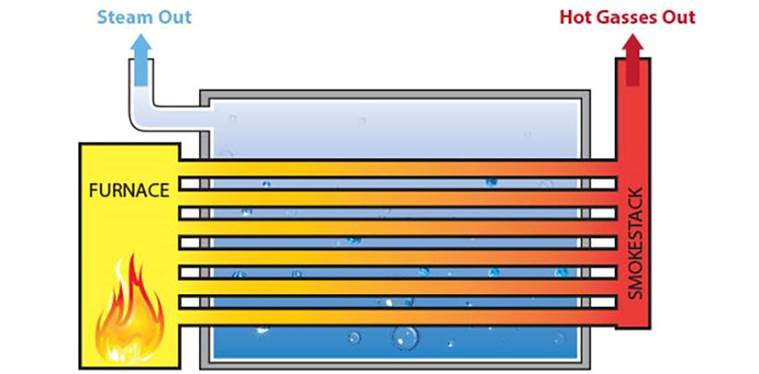
In a Fire Tube Boiler, the flame and hot gases (combustion products) pass through tubes that are located inside a large water tank. The heat of these tubes is transferred to the surrounding water, causing the water to evaporate and produce steam. (How do fire tube boilers work?)
The main structure of a fire tube boiler
- Burner: Creates the flame
- Fire Tubes: Passes the hot gases
- Shell: Contains water around the tubes
- Damper: Adjusts the flue
- Control and safety system
Difference between Fire Tube and Water Tube Boilers:
Feature | Fire Tube | Water Tube |
Flow direction | Hot gas in the pipe, water out | Water in the pipe, gas out |
Working pressure | Usually up to 25 bar | Up to 300 bar and above |
Capacity | Small to medium (up to 25 tons/hour) | Very large |
Application | Small industries, heating | Power plants, large refineries |
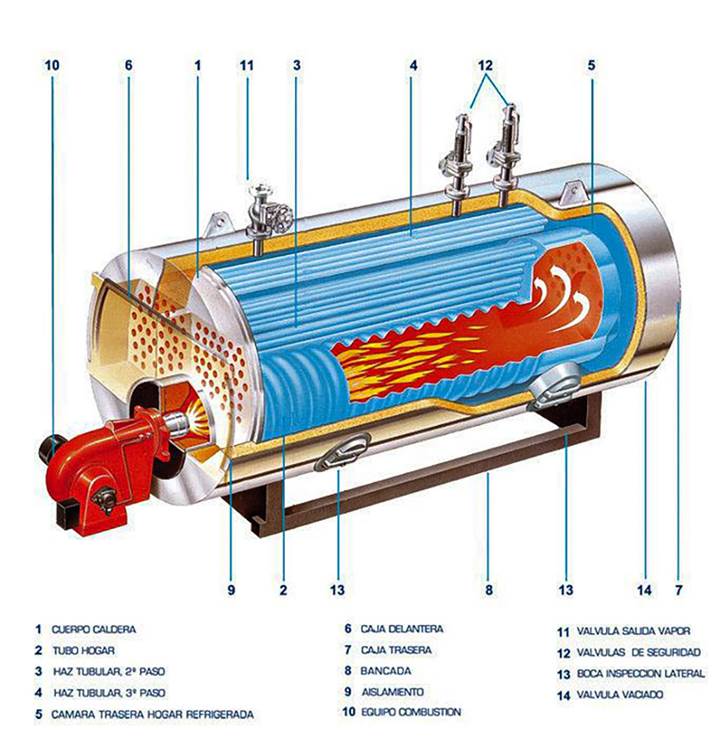
Types of Fire Tube Boilers
Four-Pass Fire Tube Boiler
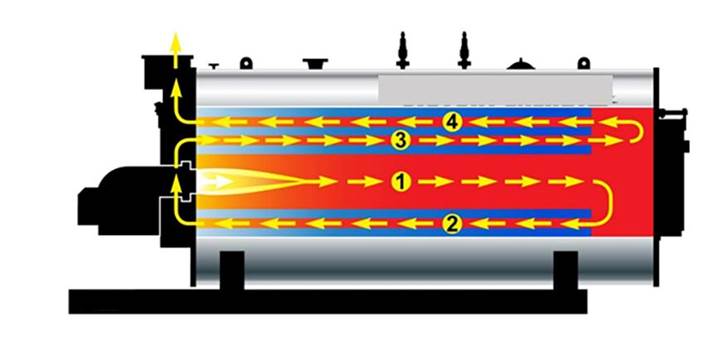
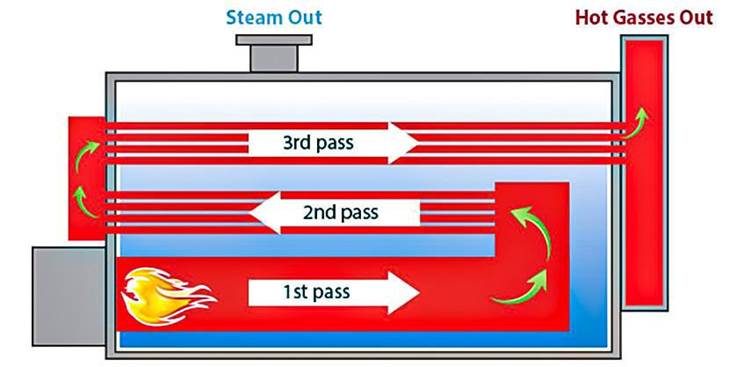
Three-Pass Fire Tube Boiler
- Hot gas passes through the tubes in three stages.
- Higher efficiency (up to 85-90%)
- Most common type in industries
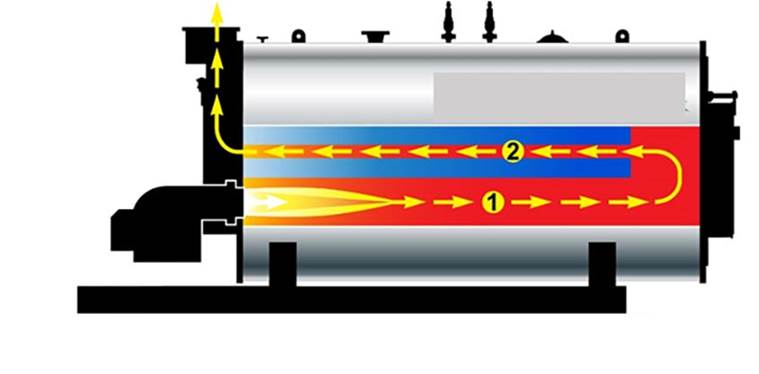
Two-Pass Fire Tube Boiler
- Simpler and cheaper
- Lower efficiency
- Suitable for small needs
Single-Pass Fire Tube Boiler
- Lowest efficiency
- Only used in special cases
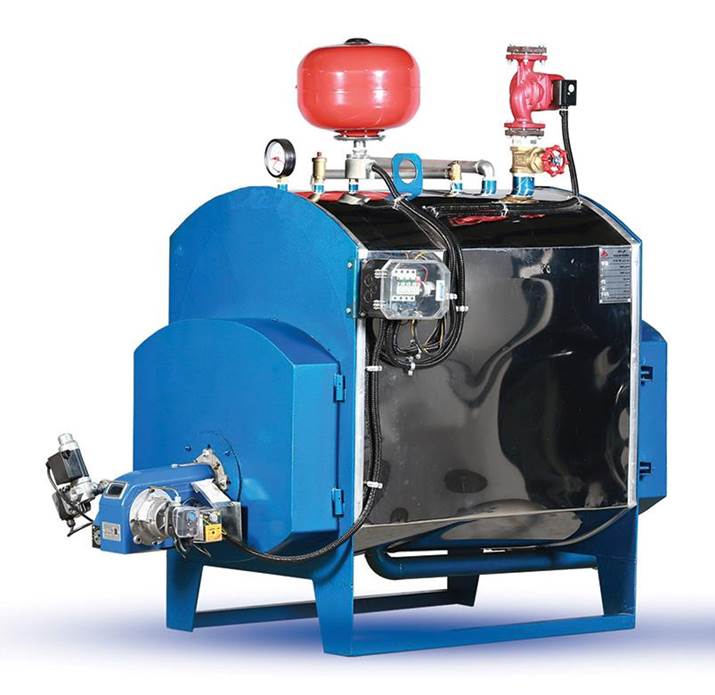
Package Boiler
- All equipment installed in one package
- Quick installation and commissioning
- Suitable for semi-fluid industries
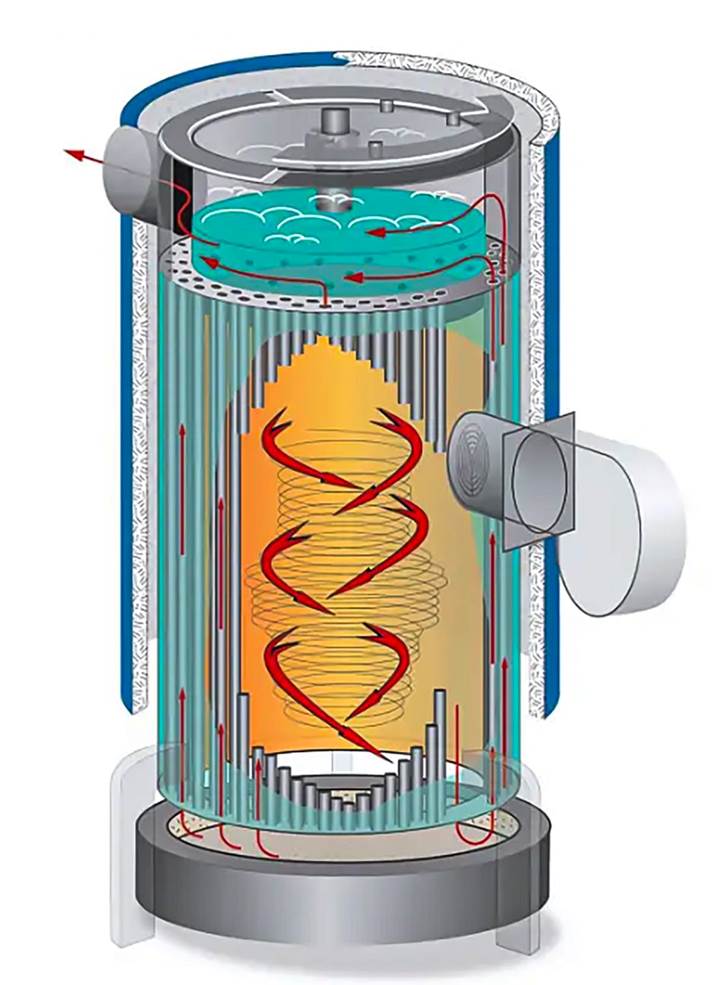
Vertical Fire Tube Boiler
- Small footprint
- Low capacity
- For small applications (e.g. steamers)
Advantages of Fire Tube Boilers
✅Fast installation and commissioning
✅Lower initial cost
✅Less space requirement
✅Easy control and high safety
✅Less manpower requirement
✅High resistance to pressure fluctuations
✅Ability to produce wet steam with acceptable quality
These advantages have made Fire Tube Boilers very popular in the food, textile, manufacturing, hospitals and heating systems industries.
Disadvantages and limitations of Fire Tube Boilers
❌Limited capacity (usually up to 25 tons of steam per hour)
❌Low working pressure (not suitable for large power plants)
❌Longer time to reach working pressure (due to high water volume)
❌Sensitivity to water quality (formation of deposits in pipes)
❌Risk of explosion in case of failure of the main tank (Shell)
❌Limited access to the inside of the pipes for cleaning
These disadvantages show that regular maintenance and prevention of deposits play a vital role in the life and safety of the device.
Fire Tube Boiler Lifespan The lifespan of a Fire Tube Boiler depends on the following factors:
Agent | Impact |
Feed water quality | Low quality→sediment→reduced life |
Maintenance plan | No washing→corrosion and cracking |
Fuel type | Improper fuel→soot and ash |
Environmental conditions | High humidity→external corrosion |
Build quality | Use of low quality steel→cracks |
Average life:
- Without proper maintenance: 8 to 12 years
- With periodic maintenance: 15 to 20 years
- With preventive maintenance and chemical washing: up to 25 years
Scaling formation in Fire Tube Boilers and its consequences
How is scale formed?
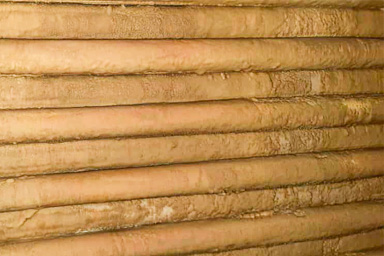
The feed water contains calcium, magnesium, bicarbonate and silica. With increasing temperature, these substances precipitate as calcium carbonate, calcium sulfate and silicate.
Consequences of scale formation:
- Reduced heat transfer (scaling is a thermal insulator)
- Increased fuel consumption
- Increased tube temperature and risk of cracking
- Reduced steam production
- Under Deposit Corrosion
Fire Tube Boiler Maintenance and Chemical Cleaning
Pre-treatment of feed water
- Water Softener
- Reverse Osmosis (RO)
- Dosing of chemicals (anti-scalant, oxygen scavenger)
Periodic Blowdown
- Partial discharge of water to reduce solids concentration
Chemical Cleaning
- Use of anti-scaling solutions to remove deposits
- Periodically (every 6 to 18 months)
- Prevent reduction in efficiency
Basic descaling
- In cases where the pipe space is more than 30% blocked
- Use of non-acidic solutions with anti-corrosion properties
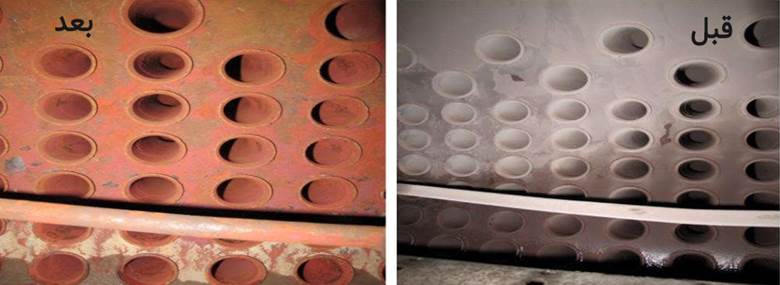
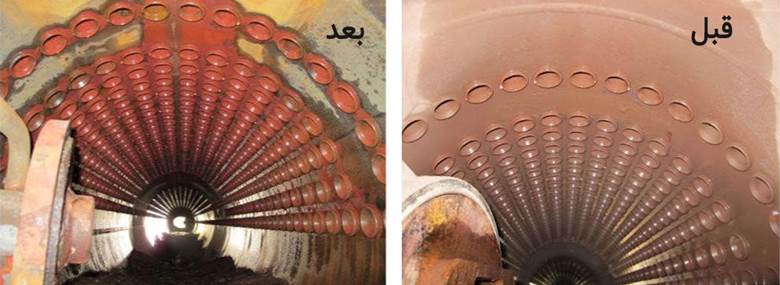
Case Study: Chemical Cleaning with Mitreh
- Specialized cleaning of boilers at Fajr Jam Gas Refinery with Mitreh solution
- Fire Tube boiler with severe efficiency loss
- After cleaning with Mitreh solution by Abrizan's expert team:
- 7% increase in boiler efficiency
- Fuel consumption decreased
- Increased steam production without worrying about blockage or corrosion
- No secondary damage or corrosion
- Full satisfaction of the Fajr Jam Refinery's technical and management team
Fire Tube Boiler Maintenance Safety Tips
- Never enter the tank without depressurizing and completely shutting down.
- Use breathing apparatus and eye protection.
- Protect all sensors and valves before chemical cleaning.
- Cleaning solutions must be non-corrosive and fully washable.
- After cleaning, a thorough water rinse is essential.
Why is it important to choose the right cleaning solution?
Using inappropriate solutions can:
- Cause corrosion
- Cause cracks in the steel
- Create new deposits
Characteristics of an ideal cleaning solution:
- Non-acidic (to prevent corrosion)
- Contains anti-corrosion agents
- Capable of dissolving carbonates, sulfates and silicates
- Fully washable without residue
✅Mitreh products with specialized formulations meet these conditions and have proven their effectiveness in hundreds of industrial projects.
Summary and Operational Recommendations
- Fire Tube Boilers are an ideal option for small and medium-sized industries.
- Periodic maintenance is the key to increasing life and efficiency.
- Chemical flushing with specialized solutions (such as Mitreh) can improve efficiency by up to 30%.
- Using a specialized team to perform the operation is essential.
- Feedwater pretreatment is the first step to prevent fouling.
Credible Sources
1. ASME Boiler and Pressure Vessel Code (BPVC)
2. API Standard 560 – Fired Heaters for General Refinery Services
3. NACE SP0106 – Control of Corrosion in Boilers
4. U.S. Department of Energy – Boiler Efficiency Guidelines
5. ScienceDirect: "Fouling in Fire Tube Boilers: Causes and Prevention"
6. Abrizan Industrial Research Company Reports – Projects Completed with Mitreh Solution
share :
Related Articles

Chemical vs. Mechanical Washing in MED: Which Method is Better?
Which method is better for cleaning MED devices? Technical comparison, cost and risk of chemical vs. mechanical cleaning.
When is the best time to thermal desalination plant washing?
Signs of need for thermal desalination plant flushing (MED/MSF) + Data-based decision-making guide.
Common challenges in desalination plant maintenance and practical solutions
6 key challenges in power plant desalination plant maintenance + practical solutions to prevent power generation outages.
Types of deposits and corrosion in heat exchangers and identification methods
A comprehensive guide to identifying calcium carbonate, sulfate, silica, iron oxide, and MIC corrosion deposits in heat exchangers using XRD and SEM methods.
Step-by-step guide to chemical boiler cleaning — professional and safe execution
Step-by-step guide to chemical boiler cleaning in compliance with ASME standards, from system shutdown to final passivation. Safe and effective execution.
Warning signs that indicate the need for chemical cleaning of the heat exchanger
Has your heat exchanger lost its efficiency? 5 warning signs (increasing temperature, decreasing ΔT, high pressure, leakage, bad smell) + quick diagnosis checklist.

Comparison of boiler cleaning methods — chemical, mechanical or hydrojet
Which boiler cleaning method is best for you? A complete comparison of chemical, mechanical, and hydrojet methods in terms of cost, safety, time, and efficiency.

Signs of Needing Chemical Backwashing of RO Water Desalination — How to Know if an RO System is "Breathing"?
Is your RO system experiencing reduced water production, increased pressure, or reduced water quality? In this comprehensive article, we explore the 10 warning signs that your RO needs chemical flushing, with technical details, industry statistics, and practical guidance. Free consultation + free sediment sample analysis from your sink.
Submit your opinion
Your email address will not be published.