
Corrosion comparison: Mitreh Cold scale remover solution (MDA0102) vs. hydrochloric acid
1404/08/24
What is the Langelier Index? A Complete Guide to Predicting Water Sedimentation and Corrosion
1404/08/21
Measuring Carbonate and Bicarbonate in Water: A Complete Guide to Alkalinity Control
1404/08/19
Warning signs that indicate the need for chemical cleaning of the heat exchanger
1404/08/17
History of corrosion and scientific approach to corrosion

Introduction: Why is corrosion the invisible enemy of industry?
Imagine an industrial boiler that has been operating without problems for years, suddenly its efficiency decreases, its fuel consumption increases and finally leaks. The reason? Invisible corrosion that has been going on for years in the heart of metals and is now showing its devastating results.
Corrosion is not just a chemical phenomenon; it is also an economic, safety and performance challenge in various industries. Every year billions of dollars are wasted due to corrosion-related damage worldwide. But the good news is that corrosion can be controlled — provided that scientific principles and up-to-date solutions are used.
In this article, while reviewing the scientific history of corrosion, we will discuss practical, experimental and applied solutions to combat it in industrial equipment such as boilers, chillers, heat exchangers and water circulation systems.

The Scientific History of Corrosion: From Rust to Materials Engineering
Corrosion throughout history
The phenomenon of corrosion began at the same time as humans used metals. The first historical references to corrosion date back to the writings of the Greek philosopher Pliny about the rusting of iron weapons. However, the scientific approach to this phenomenon began only in the 18th century.
In 1824, Humphry Davy, an English scientist, first used sacrificial anodes to protect the hulls of ships. This work is considered a turning point in the transformation of corrosion from an experimental problem into a scientific branch.
Foundations of the science of corrosion are established
1830s:The British Society for the Promotion of Science begins the first systematic studies of the corrosion of iron.
1847:Richard Addy proves that corrosion is caused by an electrochemical reaction between oxygen, water, and metal.
1903:The first course entitled "Chemical Resistance of Materials" is held in America.
1922:The Massachusetts Institute of Technology (MIT) first taught corrosion on a university campus.
These developments paved the way for the emergence of corrosion engineering as a separate discipline.

Basic Corrosion Tests in the Lab
What is corrosion? A simple and scientific definition
Corrosion is a natural process in which metals react with their surroundings (such as water, oxygen, acids, or salts) over time to form more stable compounds—such as oxides or hydroxides. This process causes loss of strength, leakage, improper heating, and ultimately equipment failure.
The most common types of corrosion in industry:
1. Uniform Corrosion
- The entire surface of the metal is eroded uniformly.
- Predictable and usually controlled by protective coatings.
2. Galvanic Corrosion
- Occurs when two dissimilar metals come into contact in an electrolyte (such as water).
- The more active metal (anode) corrodes faster.
3. Crevice Corrosion
- Occurs in crevices or places where fluid flow is restricted.
- Common in flanges, gaskets, and fittings.
4. Stress Corrosion Cracking (SCC)
- A combination of mechanical stress and a corrosive environment.
- Very dangerous, as it occurs without apparent warning.
5. Microbiologically Influenced Corrosion (MIC)
- Caused by the activity of certain bacteria in water systems.
- Common in cooling towers and water transmission lines.
Why are industrial equipment particularly susceptible to corrosion?
Equipment such as boilers, chillers, heat exchangers, thermal desalination plants, and cooling towers are subject to the most severe types of corrosion due to the nature of their work—i.e., constant contact with water, steam, chemicals, and high temperatures.
Factors that exacerbate corrosion in these systems:
- The presence of dissolved oxygen in water
- Improper pH (acidity or alkalinity of water)
- High temperature that increases the rate of chemical reactions
- Inorganic deposits (such as calcium carbonate) that create under-deposit corrosion conditions
- High-velocity water flows that create erosion corrosion
Practical solutions for controlling and preventing corrosion
1. Controlling the quality of incoming water
Water is the main factor in causing corrosion in industrial systems. Therefore:
- Reducing water hardness using softeners or deionizers
- Removing dissolved oxygen with deoxygenators or anti-oxygen chemicals
- Adjusting the pH within a safe range (usually between 8.5 and 10 for boilers)
2. Using anti-corrosion chemicals (Corrosion Inhibitors)
These materials prevent direct contact between water and metal by creating a protective layer on the metal surface. Common types:
- Phosphates and silicates for hot water systems
- Amines for steam line protection
- Molybdate or nitrite additives in closed systems
Key point: The choice of anti-corrosion agent should be based on the composition of the water, the type of metal, the temperature and the pressure of the system. Improper use can have the opposite effect.
3. Regular chemical cleaning
Over time, even with the best anti-corrosion programs, deposits and corrosion layers accumulate. Chemical cleaning:
- Improves the thermal efficiency of the equipment
- Reduces energy consumption
- Extends the life of the equipment by several years
The cleaning process should include the following steps:
1. Initial inspection: Analysis of the type of deposit and corrosion
2. Selection of the appropriate chemical solution: acidic, alkaline or mixed
3. Controlled execution: Respecting temperature, time and concentration
4. Final rinsing and neutralization
5. Application of a protective coating after cleaning

Technical team performing chemical flushing of a heat exchanger
4. Periodic testing and continuous monitoring
- Testing of inlet and circulating water (weekly or monthly)
- Checking wall thickness with ultrasonic devices
- Using corrosion coupons to measure the actual corrosion rate
This data will help you take action before failure occurs.
Frequently Asked Questions (FAQ)
❓ Are corrosion inhibitors harmful to the environment?
Some old materials (such as chromates) are toxic, but today eco-friendly corrosion inhibitors based on molybdate, citrate or natural polymers have been developed.
❓ When should we perform chemical flushing?
If:
- Thermal efficiency of the system has decreased
- Fuel or electricity consumption has increased
- Abnormal outlet temperatures are observed
It is probably time for flushing.
❓ Can corrosion be stopped completely?
No — corrosion is a natural process. But with proper planning, it can be reduced to a level that is both economically and safety-wise safe.
Conclusion: Take corrosion seriously, before it takes you seriously!
Corrosion is a slow but powerful enemy. But with sufficient knowledge, regular planning, and the use of scientific solutions, you can prevent its financial, safety, and operational losses.
If you operate in industry and have equipment such as boilers, chillers, or heat exchangers, expert, test-based advice can make a difference in the life of your equipment for several years.
✅ What should you do next?
- Share this article with your colleagues.
- Establish a water quality monitoring program for your systems.
- If you need technical advice on chemical cleaning or choosing the right anti-corrosion agent, contact experienced professionals in this field.
share :
Corrosion comparison: Mitreh Cold scale remover solution (MDA0102) vs. hydrochloric acid
1404/08/24What is the Langelier Index? A Complete Guide to Predicting Water Sedimentation and Corrosion
1404/08/21Measuring Carbonate and Bicarbonate in Water: A Complete Guide to Alkalinity Control
1404/08/19Warning signs that indicate the need for chemical cleaning of the heat exchanger
1404/08/17
Related Articles

Effect of chlorine ions on stainless steels
The effect of chlorine and chloride parameters on the corrosion of stainless steels and the parameters affecting their corrosion rate, as well as the acceptable limits of chlorine ion levels in water and the differences in the effects of free chlorine and chloride on the corrosion of corrosion-resistant steels, are stated.

Caustic corrosion
Localized corrosion caused by the concentration of caustic or alkaline salts, which usually occurs under conditions of high evaporation or heat transfer. Caustic salt or caustic soda is one of the most widely used ionic compounds and is used in various industries including water treatment, cardboard and paper production, oil and refinery industries, aluminum production industries, food industries, alcohol production and glass.

Corrosion and deposition of cooling water based on API 571
It refers to general or localized corrosion of carbon steels and other metals caused by dissolved salts, gases, organic compounds, or microbiological activity.
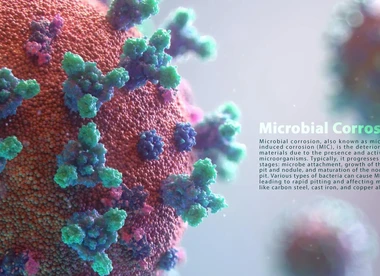
Microbial corrosion based on API 571
Microbial corrosion is a type of corrosion caused by living organisms such as bacteria, algae, or fungi. This type of corrosion is often associated with tubercles or slimy organic materials.

Corrosion process in different environments
Corrosion processes are divided into three groups in a more comprehensive classification: corrosion in aqueous solutions or environments, corrosion in molten salts and liquid metals, and corrosion in gases.

Oil-soluble corrosion inhibitor for the protection of oil transfer and storage equipment
Corrosion is a natural phenomenon that occurs as a result of the electrochemical reaction of metal with the surrounding environment. In the oil and gas industry, corrosion is one of the major problems that accounts for a huge amount of money annually. Part of these amounts are related to the corrosion of pipes or oil transmission lines. Effective ways to prevent corrosion of oil transmission and storage equipment are divided into two categories: physical and chemical solutions.

couponing
The coupon method or corrosion coupons is the simplest method of corrosion monitoring. Coupons are the oldest corrosion monitoring tool. Corrosion coupons are small pieces of metal or alloy of the material of interest that are immersed in the process medium and removed after a specified period of time and their weight or dimension loss is evaluated and examined.

Deaerators
Deaerators are mechanical devices that remove dissolved gases from the boiler feedwater. By reducing the concentration of oxygen and carbon dioxide in the solution, they minimize corrosion and protect the boiler from the effects of corrosive gases.
Submit your opinion
Your email address will not be published.