


Comparison of boiler cleaning methods — chemical, mechanical or hydrojet

Introduction: Why is it critical to choose the right boiler cleaning method?
Boilers are among the most critical pieces of equipment in industries ranging from power plants and refineries to food factories and hospitals. But over time and with constant use, mineral deposits, corrosion and feedwater contaminants can severely reduce the efficiency of these systems.
In such situations, boiler cleaning is the only way to restore optimal performance and prevent safety hazards.
But the real question is:
Which boiler cleaning method — chemical, mechanical or hydrojet — is the most cost-effective, safe, time-efficient and efficient for you?
In this article, we will transparently review all three methods from a technical, economic and safety perspective, and finally provide practical guidance on choosing the best option based on your boiler type, scale type and operating conditions.
Types of Boiler Cleaning Methods — What Options Are Available?
In general, there are three main methods for cleaning boilers:
1. Chemical Cleaning
2. Mechanical Cleaning
3. Hydrojetting / High-Pressure Water Jetting
Each of these methods has its own advantages and disadvantages, and their choice depends on factors such as the type of scale, boiler structure, physical access, budget and time available.
Chemical Boiler Cleaning — A Smart Solution for Complex Scale
What is Chemical Cleaning?
Chemical cleaning is a process in which specialized chemical solutions are used to dissolve and remove internal boiler scale (such as calcium carbonate, calcium sulfate, silica, iron oxide, etc.). This method is performed by circulating or soaking without the need to physically open the boiler.
Advantages of Chemical Cleaning
- Complete access to internal surfaces: even to places where mechanical tools cannot reach.
- Reduced risk of physical damage: No mechanical impact or abrasion to the pipe walls.
- Targeted capability: By analyzing the scale, the chemical solution can be formulated precisely based on the scale type.
- Passivation capability: After washing, a protective layer forms on the metal, preventing further corrosion.
- Time saving: No need to completely open the boiler; production downtime is minimized.

Chemical circulation system washing an industrial boiler
Disadvantages of chemical washing
- Requires high technical knowledge to select and control solutions.
- If general acids (such as hydrochloric acid) are used, there is a risk of severe corrosion of carbon steel.
- Need for proper neutralization and disposal of wastewater after operation.
✅ Key point: The use of specialized non-corrosive solutions that, in addition to high efficiency, guarantee complete safety for metals, can significantly reduce these disadvantages.
Mechanical boiler washing — a traditional method with serious limitations
How is mechanical washing performed?
In this method, the boiler is completely shut down and opened, and physical tools such as:
- Metal brushes
- Scrapers
- Cleaning rods
- or even sanding gloves
are used to remove layers of scale.
Advantages of mechanical cleaning
- No chemicals required
- Suitable for superficial and soft deposits
- Low initial cost (if performed by internal force)
Disadvantages of mechanical cleaning
- Lack of access to hidden spots: Many internal pipes or ducts are inaccessible.
- Risk of physical damage: Mechanical abrasion can damage the pipe walls and even lead to leaks.
- Time consuming: Requires longer shutdowns and extensive manual intervention.
- Failure to prevent subsequent corrosion: This method only removes the deposit, not prevents it from returning.
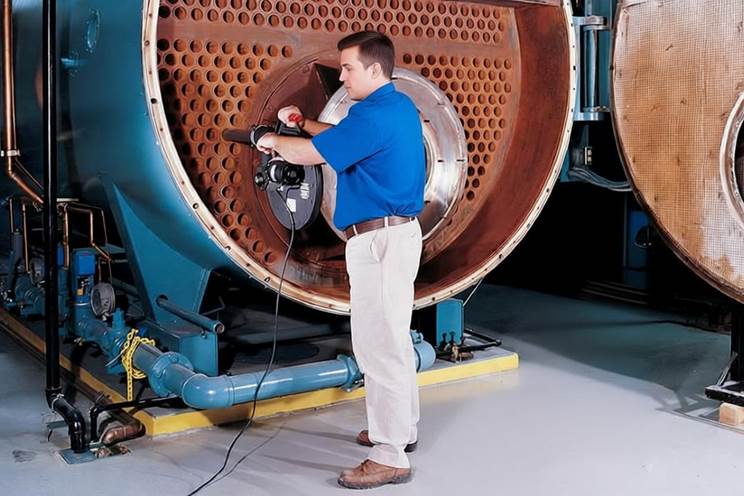
A technician uses a mechanical tool to clean the inside of a firetube boiler
⚠️Industry Alert: According to the American Society of Mechanical Engineers (ASME), more than 35% of boiler failures after mechanical cleaning are due to unintentional mechanical damage to the metal surface.
Hydrojetting (Hydraulic) Cleaning — The Power of High-Pressure Water
What is hydrojetting and how does it work?
Hydrojetting, or high-pressure water cleaning (typically between 1,000 and 40,000 psi), is a method in which a very high-velocity jet of water is used to remove deposits from the inside of the tubes. This method is commonly used in firetube boilers or systems with direct access to the tubes.
Advantages of hydrojet
- High efficiency in hard and sticky deposits
- No chemicals
- Relatively high speed compared to manual mechanical method
Disadvantages of hydrojet
- Requires direct access to pipes: Limited use in water tube boilers or complex systems.
- Risk of damage to welds and seams: High water pressure can damage weak points of the metal.
- No effect on subsurface corrosion: Only cleans the surface layer, not eliminating the root cause of corrosion.
- Requires expensive equipment and skilled labor

Industrial hydrojet machine cleaning boiler tubes
Comprehensive comparison table — chemical vs mechanical vs hydrojet
Criteria | Chemical washing | Mechanical washing | Hydrojet washing |
Efficiency in complex sediments | ⭐⭐⭐⭐⭐ | ⭐⭐ | ⭐⭐⭐ |
Access to hidden spots | ⭐⭐⭐⭐⭐ | ⭐ | ⭐⭐ |
Risk of damage to equipment | ⭐ (with specialized solution) | ⭐⭐⭐⭐ | ⭐⭐⭐ |
Production downtime | Short (12–48 hours) | Long (3–7 days) | Medium (1–3 days) |
Implementation cost | Medium to high | Low (but hidden high cost) | Top |
Preventing further corrosion | Yes (with passivation) | No | No |
Need for technical expertise | Top | Down | Medium |
Suitable for water tube boilers | Yes | No | Limited |
Table Conclusion: For most industries, chemical cleaning is the only method that is both fully effective and maintains the safety of the equipment.
Why is chemical cleaning preferable in most cases?
1. Complete coverage of internal surfaces
Even in the most complex boiler systems (such as HRSG or power plant water tubes), the chemical solution reaches all points.
2. Adaptability to deposit types
With laboratory analysis (XRD, ICP, SEM), it is possible to accurately identify what type of deposit is present and what chemical formula is optimal for it.
3. Increase the life of the equipment
Chemical cleaning combined with passivation creates a layer of protective oxide (such as Fe₃O₄) on the metal surface, which prevents oxygen corrosion and sub-deposition.
4. Long-term savings
Despite the relatively higher initial cost, a 20-30% reduction in fuel consumption and avoidance of tube replacements guarantees ROI (return on investment) in less than 6 months.
Real example from an industrial project:
In a petrochemical unit, after chemical cleaning of a water tube boiler, the tube wall temperature was reduced from 318°C to 256°C and natural gas consumption was reduced by 28%. This was equivalent to an annual saving of more than 1.2 billion Tomans.
When to use each method? Practical decision-making guide
✅ The use of chemical cleaning is recommended if:
- Your boiler is a water tube, HRSG or package.
- The deposits include carbonate, sulfate, silica or iron oxide.
- Physical access to the tubes is limited.
- You want to both remove the deposit and prevent future corrosion.
✅ Using hydrojet is suitable if:
- Your boiler is a firetube.
- The deposits are thick and hard but superficial.
- Hydrojet equipment is available and there is a specialist workforce.
⚠️ Mechanical washing is only recommended in the following cases:
- Very superficial and soft deposits (e.g. in domestic hot water boilers).
- No other method is available.
- As a supplement after chemical washing for final cleaning.
The role of a specialized laboratory in choosing the optimal method
To choose the best washing method, it is essential to accurately identify the type of deposit.
In many cases, deposits are mixed (e.g. calcium carbonate and iron oxide at the same time) and using a general method can be ineffective or even destructive.
Therefore, it is recommended to:
1. Collect a sample of the deposit or feed water.
2. Perform XRD (to identify crystalline phases), ICP-OES (for dissolved elements) and SEM-EDS (for surface structure) analyses.
3. Based on the results, choose the right method and solution.
This scientific, data-driven approach minimizes implementation risks and maximizes efficiency.
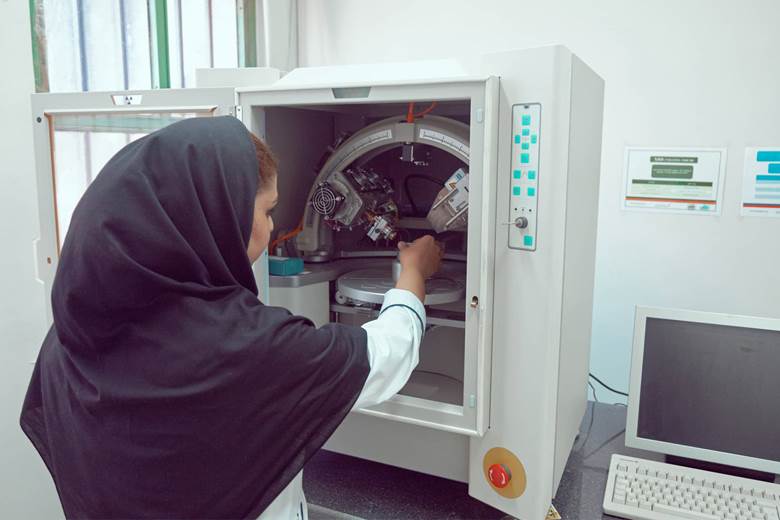
Specialized laboratory performing XRD analysis on boiler scale sample
Conclusion: Chemical Cleaning — A Smart Investment for Your Industry
Although all three boiler scale cleaning methods have their uses, chemical cleaning with specialized solutions is the only solution that:
- Provides complete efficiency
- Ensures equipment safety
- Prevents future corrosion
- Provides significant savings in the long term
If your boiler is experiencing reduced efficiency, increased fuel consumption, or pressure fluctuations, now is the time to act.
Need expert guidance?
If you need help identifying the type of scale, choosing a scale cleaning method, or having it professionally performed, you can consult with the technical teams of companies with extensive experience in chemical cleaning of industrial equipment. One of these research units that provides comprehensive laboratory and implementation services is Abrizan Industrial Research Company, which helps industries make more accurate decisions with a scientific approach.
share :
Related Articles

Chemical vs. Mechanical Washing in MED: Which Method is Better?
Which method is better for cleaning MED devices? Technical comparison, cost and risk of chemical vs. mechanical cleaning.
When is the best time to thermal desalination plant washing?
Signs of need for thermal desalination plant flushing (MED/MSF) + Data-based decision-making guide.
Common challenges in desalination plant maintenance and practical solutions
6 key challenges in power plant desalination plant maintenance + practical solutions to prevent power generation outages.
Types of deposits and corrosion in heat exchangers and identification methods
A comprehensive guide to identifying calcium carbonate, sulfate, silica, iron oxide, and MIC corrosion deposits in heat exchangers using XRD and SEM methods.
Step-by-step guide to chemical boiler cleaning — professional and safe execution
Step-by-step guide to chemical boiler cleaning in compliance with ASME standards, from system shutdown to final passivation. Safe and effective execution.
Warning signs that indicate the need for chemical cleaning of the heat exchanger
Has your heat exchanger lost its efficiency? 5 warning signs (increasing temperature, decreasing ΔT, high pressure, leakage, bad smell) + quick diagnosis checklist.

Signs of Needing Chemical Backwashing of RO Water Desalination — How to Know if an RO System is "Breathing"?
Is your RO system experiencing reduced water production, increased pressure, or reduced water quality? In this comprehensive article, we explore the 10 warning signs that your RO needs chemical flushing, with technical details, industry statistics, and practical guidance. Free consultation + free sediment sample analysis from your sink.

Signs of Need for Chemical Flushing of MED Water Desalination Plant - A Comprehensive Guide to Diagnosis, Analysis and Immediate Action
Signs of the need for chemical cleaning of MED water softeners — increased steam consumption, reduced water production, leaks, increased temperature. Guide to identifying the type of scale and specialized cleaning solutions by Abrizan (Mitreh brand).
Submit your opinion
Your email address will not be published.