
Boiler
Industrial antifreeze and anti-boiler: A complete guide to protecting heating and cooling systems
Why are industrial antifreeze and anti-scaling agents essential for circulating systems? A comprehensive guide to preventing freezing, scalding, corrosion and deposits in boilers, chillers and engine rooms

Step-by-step guide to chemical boiler cleaning — professional and safe execution
Step-by-step guide to chemical boiler cleaning in compliance with ASME standards, from system shutdown to final passivation. Safe and effective execution.
Comparison of boiler cleaning methods — chemical, mechanical or hydrojet
Which boiler cleaning method is best for you? A complete comparison of chemical, mechanical, and hydrojet methods in terms of cost, safety, time, and efficiency.
Types of deposits and corrosion in boilers + accurate detection methods
Types of deposits and corrosion in boilers — calcium carbonate, sulfate, silica, iron oxide, oxygen corrosion, sub-deposition, alkaline. Accurate detection methods with XRD, SEM, ICP. Specialized services of Abrizan (Mitreh brand).

Warning signs of the need for boiler chemical washing
Warning signs that a boiler needs chemical cleaning .a complete guide to detecting scale, the difference between anti-scale and scale remover, a step-by-step cleaning method, and a comparison of repair versus prevention costs. Abrizan Specialized Services (Mitreh Brand).
Why do boilers experience reduced efficiency and safety hazards over time?
Boilers experience reduced efficiency and serious safety risks over time. In this comprehensive article, we examine the scientific and industrial causes of this phenomenon — including scale, corrosion, increased fuel consumption and the risk of pipe bursting — with real statistics. Abrizan’s specialized solutions to prevent these risks

Water Tube Boilers | Types and Structure
Comprehensive review of water tube boilers, their types, scale formation, reduced efficiency, and maintenance solutions with specialized Mitreh solutions to increase life and reduce fuel consumption

Fire Tube Boilers
A complete review of fire tube boilers, their types, advantages and disadvantages, useful life, scale formation, and preventive maintenance solutions using specialized chemicals is available.

Types of boilers and their applications in industry
Introduction to boiler types including Fire Tube, Water Tube, HRSG and Package. Applications, advantages and disadvantages of each type and a guide to optimal selection for the oil, gas and refinery industries.
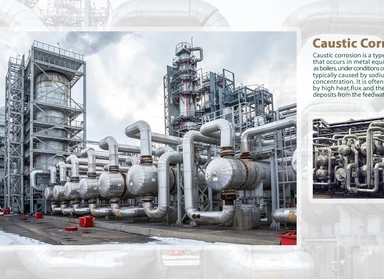
Caustic corrosion
Localized corrosion caused by the concentration of caustic or alkaline salts, which usually occurs under conditions of high evaporation or heat transfer. Caustic salt or caustic soda is one of the most widely used ionic compounds and is used in various industries including water treatment, cardboard and paper production, oil and refinery industries, aluminum production industries, food industries, alcohol production and glass.
Industrial Mitreh (sediment remover and anti-corrosion)
Any system where temperature and water are the main elements for its operation inevitably requires the invention of Abrizan Company, called Industrial Mitreh, because wherever there is temperature and water, the formation of sediment is inevitable, unless a substance is used that suspends these sediments. This is the main function of an excellent anti-sediment solution.
Water management in refineries
Feedwaters to a refinery are usually treated before being used in various processes. The type of treatment depends on the quality of the source water and its end use in the refinery. Turbidity, sediment, and hardness are examples of source water characteristics that may require treatment.
Cold Mitreh
Cold Mitreh, a water-soluble solution with a high dissolution rate, is introduced as a powerful scale remover and an innovative product of Abrizan Company. Cold Mitreh was developed in response to the industry's need for an alternative solution to descalers. Descalers are scale removers based on hydrochloric acid and are highly dangerous, toxic, and corrosive.
Boiler cleaning
Steam boilers are mainly made of carbon steels, and the internal surface of these metals that are in contact with water must be free of deposits. Deposits have a lower thermal conductivity than metals, which causes the temperature of the metal to rise on the combustion wall side. Therefore, more fuel is needed to produce steam. Therefore, there is a need to control and wash these deposits inside the steam boiler.
Boiler emergencies and their control methods
Because few people can think clearly and rationally during a crisis, it is important to be prepared to respond to such situations. Emergencies can be natural or man-made, such as floods, storms, fires, releases of toxic gases, or chemical spills.

Corrosion in boilers
Corrosion in steam boilers is caused by chemical and electrochemical reactions of metal with its surrounding environment. The most important corrosion factors in steam boilers are oxygen corrosion, carbon dioxide corrosion, corrosion due to pH drop, alkalinity corrosion, corrosion of hydrolyzable salts and corrosion of organic materials.